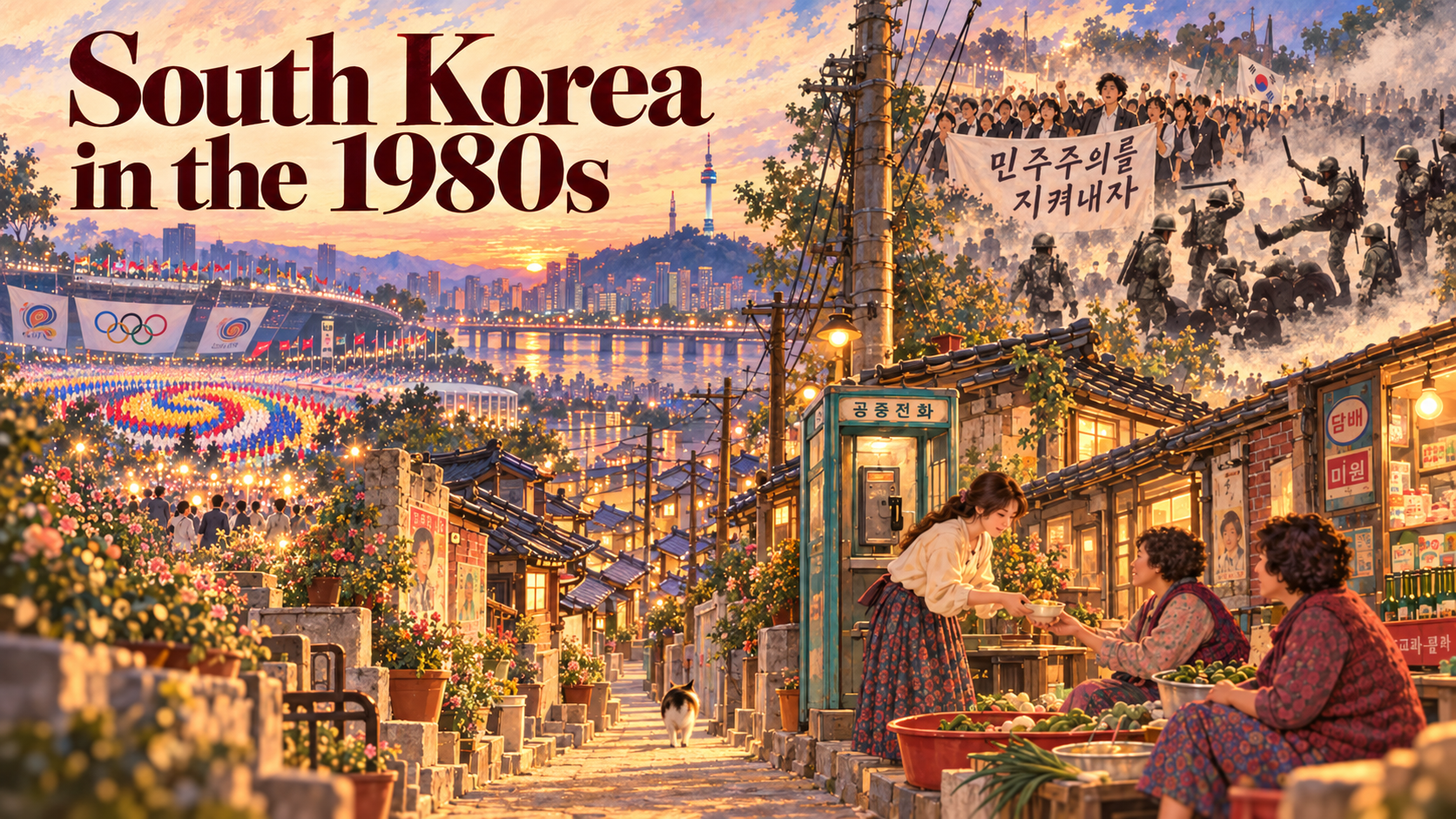
South Korea in the 1980s was a decade of military rule, democracy protests, rapid economic growth, and the Seoul Olympics. But what was life really like behind the nostalgic neighborhoods and family stories in Reply 1988? Let’s explore the history, culture, and everyday lives that shaped modern Korea.
South Korea in the 1980s: Military Dictatorship and the Fight for Democracy
Today, South Korea is known for its democratic elections and vibrant culture. However, the country’s modern democracy has a relatively short history.
After centuries of monarchy under the Joseon Dynasty and Japanese colonial rule from 1910 to 1945, the Republic of Korea was established in 1948.
The country subsequently experienced periods of authoritarian rule under Syngman Rhee (1948–1960), Park Chung-hee (who seized power in 1961 and ruled until 1979), and Chun Doo-hwan (1980–1988).
The 1980s, in particular, were marked by political repression under Chun Doo-hwan’s military-backed government and growing demands for democracy.
Chun seized military power through the December 12, 1979 coup, an event depicted in the Korean blockbuster 12.12: The Day, also known as Seoul Spring.
One of the darkest chapters of this period was the May 18 Democratic Uprising in Gwangju in 1980.
Beginning on May 18, martial law troops violently suppressed citizens protesting against military rule. Soldiers used firearms, bayonets, and physical violence, while numerous civilians were arrested and detained. Helicopter gunfire has also been documented in investigations of the crackdown.
The human cost was devastating. According to figures reported by a May 18 victims’ family association in 2007, 606 people were counted across three categories: 165 who died during the uprising, 65 who went missing, and 376 who died after suffering injuries.
These figures reflect that organization’s historical accounting, rather than a universally agreed final death toll.
Today, the Gwangju Uprising is remembered as a defining moment in South Korea’s struggle for democracy.
It has also inspired numerous works of literature and film, including Human Acts by Han Kang, the winner of the 2024 Nobel Prize in Literature.
Seven years later, another major turning point arrived.
In 1987, the death of university student Park Jong-chul under police torture helped spark nationwide pro-democracy demonstrations.
Students, office workers, and ordinary citizens filled the streets, confronting tear gas and violent police crackdowns. Special police units, including officers commonly known as the Baekgoldan or “White Skull Squad,” became symbols of the authorities’ aggressive suppression of protests.
The June Democratic Struggle eventually led to constitutional reforms restoring direct presidential elections, paving the way for a new administration in 1988.
The Korean film 1987: When the Day Comes portrays these events and the courage of those who fought for political freedom.
Just as 1989 became a turning point for democracy in parts of Eastern Europe, 1987 became a defining year in South Korea’s democratic history.
South Korea in the 1980s: The Miracle on the Han River and the Seoul Olympics
While South Korea was experiencing political turmoil, its economy was undergoing remarkable growth.
The export-driven industrialization that began in the 1960s and 1970s continued throughout the 1980s.
Industries such as automobiles, electronics, and shipbuilding expanded rapidly, allowing Korean companies to establish a stronger presence in international markets.
Between 1983 and 1988, South Korea experienced exceptionally strong economic growth, averaging roughly 10% annually.
This longer period of rapid development became internationally known as the Miracle on the Han River.
However, the benefits of economic growth were not shared equally.
Many workers faced long hours, difficult working conditions, and limited labor rights. In 1987, large-scale labor protests spread across the country as workers demanded better wages, safer workplaces, and independent labor unions.
Another landmark event was the 1988 Seoul Olympics.
Athletes and visitors from around the world gathered in Seoul, giving South Korea an opportunity to introduce itself to a global audience.
The Olympics represented more than a sporting event. They symbolized the country’s growing economic strength and international presence.
There is an interesting comparison with Japan.
The 1964 Tokyo Olympics showcased Japan’s postwar recovery and modernization. Similarly, the 1988 Seoul Olympics became an important symbol of South Korea’s transformation.
Seoul itself was also changing rapidly.
Roads and subway networks expanded, apartment buildings became increasingly common, and traditional neighborhoods gradually gave way to modern urban development.
Much of the Seoul we recognize today grew out of the economic and social changes of this period.
South Korea in the 1980s: Everyday Korean Life in Reply 1988
If you want to experience the atmosphere of 1980s Korea through a K-drama, one of the best places to start is Reply 1988.
Set in Ssangmun-dong, a neighborhood in Seoul, the series follows five families and their close-knit community in 1988.
The drama beautifully recreates the everyday details of the period.
Narrow alleyways, modest family homes, coal-briquette heating systems, small neighborhood stores, and public payphones offer a glimpse into Korean life before smartphones and modern apartment complexes became part of everyday life.
What stands out to me most is the relationship between neighbors.
Families regularly share homemade side dishes, walk into each other’s homes without much formality, and treat their neighbors almost like extended family.
As a Korean woman in my twenties, I find these scenes especially fascinating because the Seoul depicted in the drama feels so different from the city I know today.
Modern Korean life places greater emphasis on personal space and privacy, particularly in large apartment complexes.
In Reply 1988, however, the entire neighborhood often feels like one big family.
These relationships help explain the strong sense of community that existed in many Korean neighborhoods during that era.
Another important part of 1980s Korean culture was the rise of professional baseball.
The Korea Baseball Organization (KBO) League began in 1982, introducing professional teams associated with different cities and regions, including Seoul, Busan, Daegu, and Gwangju.
Baseball quickly became a major form of entertainment, with passionate fans supporting their hometown teams.
Much like Major League Baseball in the United States, Korean professional baseball developed strong connections to regional identity and local pride.
When watching Reply 1988, it’s easy to focus on the friendships, family relationships, and romantic moments.
But the series also reveals something deeper.
Even during a decade defined by political struggles and rapid economic change, ordinary Koreans were falling in love, raising families, celebrating special occasions, and cheering for their favorite sports teams.
These everyday stories are just as important to understanding Korean history as the major political events of the time.
Closing: Discovering Korea’s Real History Through K-Dramas
South Korea in the 1980s was a decade when politics, the economy, and everyday culture were all undergoing dramatic changes.
While citizens continued their struggle against military-backed authoritarian rule, the country experienced remarkable economic growth and gained international recognition through the 1988 Seoul Olympics.
What I find particularly interesting is how Reply 1988 and 1987: When the Day Comesshow two very different sides of the same era.
One captures the warmth of family life, friendship, and neighborhood communities.
The other portrays the courage of ordinary people who fought for democracy.
And both stories were part of the same Korean reality.
If you want to understand the family relationships, workplace culture, and social values portrayed in today’s K-dramas, exploring the history of 1980s Korea can offer a fascinating new perspective.
You may begin to see that many aspects of modern Korean life, including freedoms often taken for granted, were shaped by the struggles, sacrifices, and everyday choices of earlier generations.