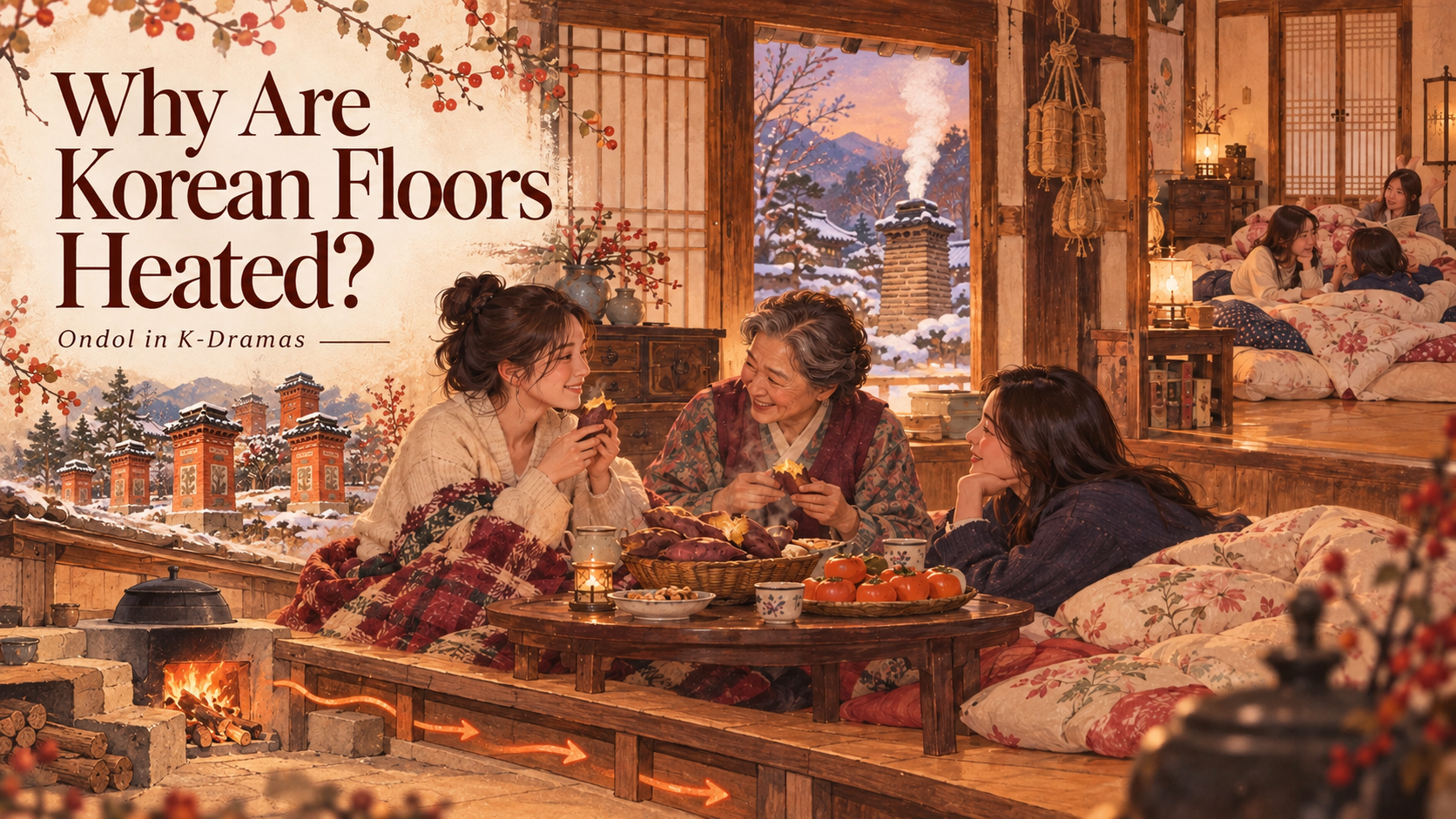
Have you noticed how K-Drama characters sit and sleep on warm floors in winter? Discover Korean floor heating, the ancient Ondol system that shaped Korean homes, family traditions, and everyday life.
Korean Floor Heating: Where Did Ondol Begin?
If you watch K-Dramas, you’ve probably noticed characters sitting on the floor instead of the sofa, even during freezing winters. Sometimes, they even spread blankets directly on the floor and go to sleep.
If you’re unfamiliar with Korean homes, you might wonder, “Isn’t the floor too cold and uncomfortable?”
The secret is Ondol, Korea’s traditional underfloor heating system.
The Korean word Ondol (온돌, 溫突) literally refers to heated stone. Instead of heating a room only through the air, Korean floor heating warms the floor itself, making it comfortable to sit, relax, and sleep on.
Its history dates back 5,000 years. Early traces of Ondol heating can be found in Gojoseon, considered the first ancient Korean kingdom, which emerged during the Bronze Age. The heating system continued to develop through the Goguryeo Kingdom and the Three Kingdoms period. Initially, only certain parts of a room were heated. By the late Goryeo Dynasty, more advanced systems capable of heating the entire floor had emerged, and Ondol gradually spread throughout Korea during the Joseon Dynasty.
At first, only certain sections of a room were heated. By the later Goryeo period, more advanced systems could warm the entire floor. During the Joseon Dynasty, Ondol became increasingly widespread in Korean homes.
Interestingly, ancient Rome had a similar technology called the hypocaust. It circulated hot air beneath floors and was commonly used in public bathhouses and wealthy residences.
However, while the Roman hypocaust did not remain a standard feature of everyday European homes, Ondol continued evolving as an important part of Korean residential life.
This doesn’t mean Korea invented the world’s first heated floor. What makes Ondol remarkable is how an ancient heating tradition survived and developed into something Koreans still use today.
Korean Floor Heating: The Clever Science Behind Warm Floors
One of the most fascinating features of traditional Ondol was that a single fire could be used for both cooking and heating.
In traditional Korean houses, called hanok, a fire was lit in a kitchen furnace known as an agungi.
Hot smoke and gases traveled through channels beneath the floor before escaping through a chimney. As they passed underneath, they heated the flat stones and surrounding materials that formed the floor.
These materials stored heat and gradually released it into the room, helping the floor remain warm even after the fire had burned down.
Unlike a traditional fireplace, which mainly warms the surrounding air and nearby surfaces, Korean floor heating warms the space from below. Heat radiates upward from the floor, while air movement also helps distribute warmth throughout the room.
This made Ondol especially suitable for a lifestyle where people regularly sat and slept on the floor.
The design of traditional hanok houses also reflected Korea’s distinct seasons.
In summer, their extended roof eaves helped block the strong sunlight from the high summer sun. In winter, when the sun was lower in the sky, more sunlight could enter the house.
Together, these architectural features helped people adapt to Korea’s hot summers and cold winters.
At Gyeongbokgung Palace, you can see the Amisan Chimneys behind Gyotaejeon, the queen’s residence, and the Ten Longevity Symbols Chimney at Jagyeongjeon Hall. Both were part of the traditional Ondol heating system. During the Joseon Dynasty, it is said that people could even estimate a household’s wealth by the number of chimneys it had.
Today, most Korean apartments no longer use traditional wood-burning furnaces. Instead, modern Korean floor heating systems usually circulate hot water through pipes installed beneath the floors.
Although the technology has changed, the basic idea remains the same: keep the floor warm, and the entire room becomes more comfortable.
Unlike in countries where underfloor heating may be an optional luxury, it has become an ordinary part of everyday housing in South Korea.
Korean Floor Heating: How Ondol Shaped Korean Family Traditions
Ondol did more than keep Korean homes warm. It also influenced how families spent time together and how younger generations learned to respect their elders.
I still remember visiting my great-grandmother’s house in the Korean countryside during winter when I was little.
The floor beneath the thick blankets was unbelievably hot. Sometimes, it was almost too hot to keep my feet in one place!
I also remember seeing meju, traditional fermented soybean blocks used to make Korean condiments, hanging from the ceiling.
Even now, those memories remind me of the special warmth of an old Korean country house.
Traditional Ondol rooms had two important areas: araetmok (아랫목) and witmok (윗목).
Araetmok was the warmer part of the room, usually located closer to the furnace. Witmok was farther away and relatively cooler.
The warmest spot wasn’t simply the most comfortable place. It was also traditionally considered a seat of honor, often reserved for parents, grandparents, or elderly guests.
Children learned to offer the warmer spot to their elders, naturally practicing the Korean tradition of respecting older generations.
Araetmok was also a gathering place for families.
On cold winter evenings, family members would sit together with their feet tucked beneath blankets, sharing roasted sweet potatoes or sweet persimmons while talking about their day.
In many traditional Western homes, the fireplace served as a central gathering place. In Korea, the warmest part of the Ondol floor played a similar role.
You can still see traces of this culture in modern K-Dramas.
Families gather around low tables to eat together, friends spread blankets on the floor during sleepovers, and characters sit comfortably on the living room floor while talking.
These scenes are connected to Korea’s long tradition of treating the floor as an important part of everyday living space.
So when you notice people sitting on the floor in a K-Drama, remember that Korean floor heating is part of a much bigger cultural story.
Closing: The Warmth Beneath Korean Homes
In K-Dramas, characters often take off their shoes before entering a home, sit on the floor to eat, or lay out blankets to sleep.
These aren’t just random habits. They reflect a way of life shaped in part by centuries of Ondol culture.
For me, Ondol is much more than an old heating invention. It brings back childhood memories of my great-grandmother’s house, the incredibly hot stone floor, and the comforting warmth of a Korean winter.
Next time you watch a K-Drama and see characters gathered on a warm floor, think about the history and family traditions hidden beneath their feet.
Korean floor heating has done more than warm people’s homes. It has also helped bring families closer together.
