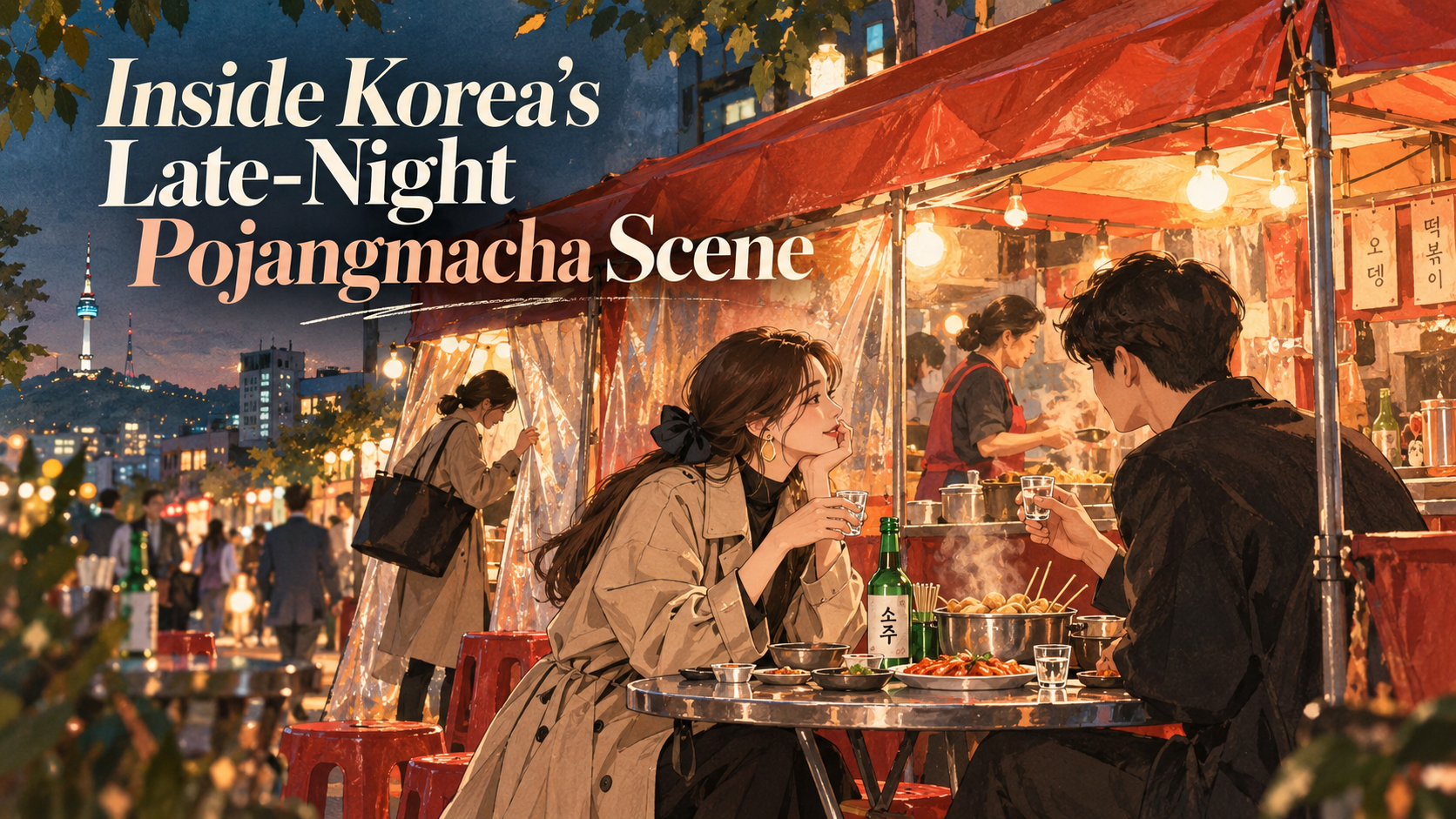
Ever wondered about the red street tents in K-Dramas? Pojangmacha is a Korean night spot where people share simple food, drinks, and honest conversations.
What Is a Pojangmacha? The Red Tent You See in K-Dramas
If you watch Korean dramas, you have probably seen this scene before: an exhausted office worker sits alone with a bottle of soju, or two characters sit across from each other late at night and finally talk about what they have been holding inside. Very often, the setting is a small tent on the street. That place is called a Pojangmacha.
Pojangmacha originally developed from street carts covered with tents that sold simple food and alcohol. During the 1950s and 1960s, vendors often set up poles around carts and covered them with fabric to protect customers from rain, wind, and cold. By the 1980s, the familiar tent-style Pojangmacha had become part of Korea’s urban nightlife.
The food was usually simple and affordable. Typical dishes included eomuk, or fish cake, noodles, sundae, which is Korean blood sausage, chicken feet, and grilled fish, often served with soju or makgeolli.
For international readers, a Pojangmacha can be compared partly to an American food truck, but there is one major difference. People do not simply buy food and leave. Traditionally, customers sit down, drink, eat, and talk. In that sense, it can also feel a little like a neighborhood pub in the UK, where people stop after work to relax and catch up with friends.
Why Pojangmacha Became a Special Place for Ordinary Koreans
During the 1970s and 1980s, Pojangmacha became closely associated with office workers and laborers looking for an inexpensive place to relax after a long day. Compared with restaurants, these street tents were casual and affordable. People could stop on their way home, order a bottle of soju and a simple dish, and talk with friends or coworkers.
At the same time, Pojangmacha were important places of work. For many vendors, running a small cart and tent offered a way to earn a living without opening a full restaurant. This is one reason Pojangmacha became closely connected with the everyday lives of working-class Koreans.
Whenever I think about Pojangmacha, I remember a story my father once told me. When he was younger, he was drinking at a Pojangmacha when he unexpectedly met a senior from his school. The senior left first, but before leaving, he quietly paid my father’s entire bill as well.
It may sound like a small gesture today, but stories like this capture something about the atmosphere of old Pojangmacha: unexpected meetings, shared drinks, casual conversations, and small acts of generosity between people.
You might compare it with a Japanese izakaya, where people enjoy drinks and small dishes together. The difference is that a traditional Korean Pojangmacha was much more temporary and informal, often consisting of little more than a street cart, plastic tables, and a tent.
Why Pojangmacha Scenes Appear So Often in K-Dramas
In K-Dramas, a Pojangmacha is rarely just a place to drink.
It is often where an office worker goes after having a terrible day, where friends finally share their worries, or where two people in love say the things they could not say anywhere else.
The setting works especially well for emotional scenes. Unlike a stylish restaurant, a small tent feels informal and intimate. Characters sit close together, with bottles of soju and simple dishes between them. There is little ceremony, which makes it easier for a scene to feel personal and honest.
For international viewers, this emotional role may actually feel familiar.
In an American drama, a character might go to a neighborhood bar after a difficult day and talk to a close friend. In a British drama, a similar conversation might happen over a drink at a local pub. A Korean Pojangmacha often serves the same storytelling purpose.
The setting looks very different, but the basic idea is similar: it is a place where people can sit down after a long day, have a drink, and finally say what they are really thinking.
Today, traditional street Pojangmacha are less common than they once were, while indoor restaurants inspired by the old Pojangmacha style have become popular. Even so, the familiar image of steaming fish cake broth, green soju bottles, plastic tables, and a tent glowing at night remains strongly connected with Korean nightlife.
Understanding Pojangmacha Makes K-Dramas Feel Different
The next time you see a character push open the plastic curtain of a Pojangmacha late at night, it may help to remember that it is more than just a cheap bar.
These small spaces are connected to Korea’s urban history, working-class life, and the culture of having a drink after work to unwind. For some people, a Pojangmacha was a workplace and a way to support a family. For others, it was simply somewhere to sit down and forget about a difficult day for a little while.
Although Pojangmacha culture has changed over the decades, its warm and unpretentious atmosphere is still alive in K-Dramas.
Once you understand what a Pojangmacha represents, those familiar night scenes can feel a little different. A bottle of soju and a steaming plate of food may suddenly carry more meaning — loneliness, comfort, friendship, generosity, or even love.
