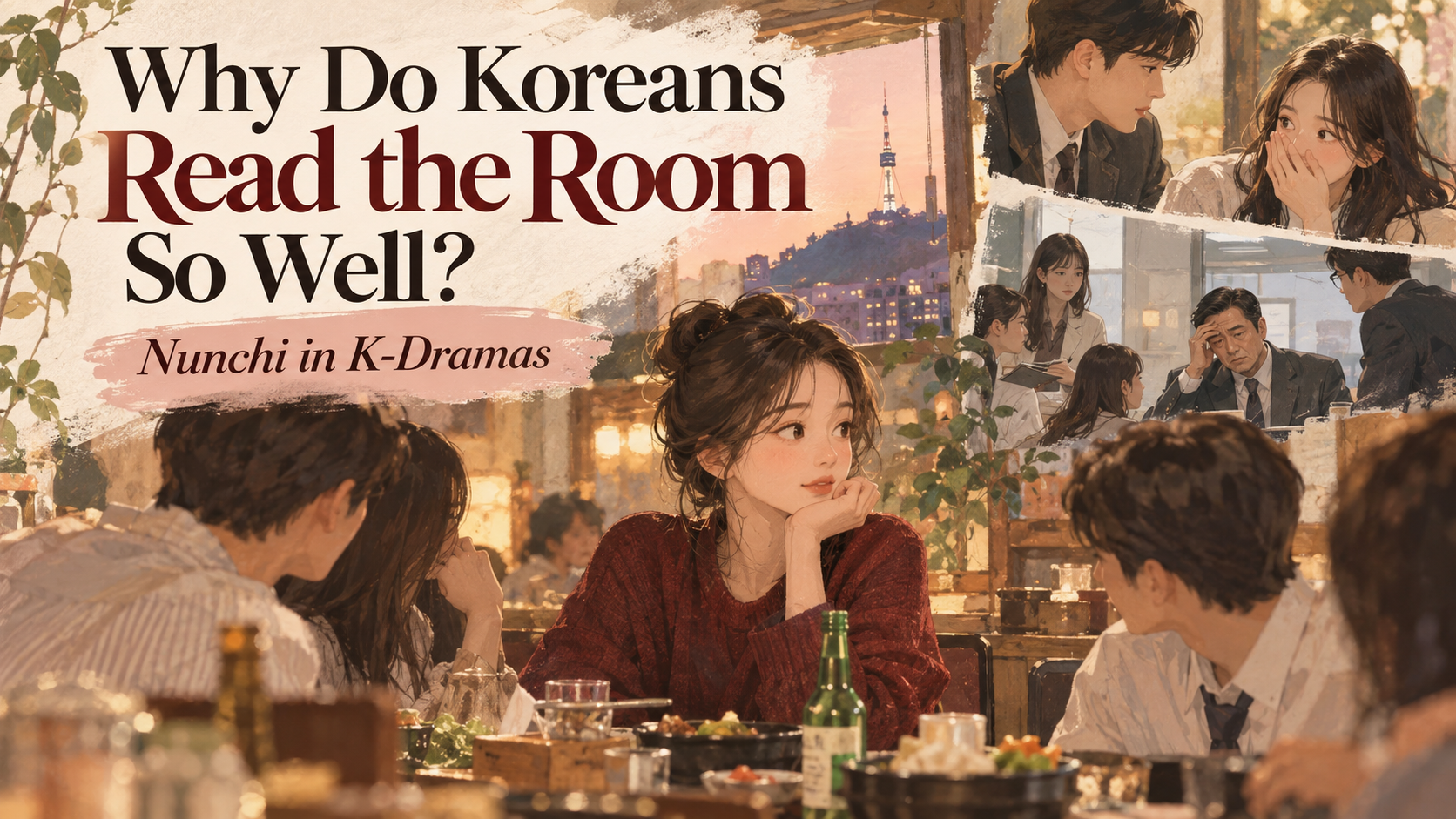
Why do K-Drama characters seem to understand a situation without anyone saying a word? Discover the Nunchi Meaning, how Koreans read the room, and how this social skill differs from Japan’s culture of reading the atmosphere.
Nunchi Meaning: What Does Nunchi Actually Mean in K-Dramas?
If you watch K-Dramas, you may have heard Koreans say things like “Have some nunchi,” “You’re quick at reading nunchi,” or “Why do you have no nunchi?”
The Nunchi Meaning is close to the English expression “read the room,” but the Korean concept is a little broader. Nunchi is the ability to quickly notice someone’s facial expression, tone of voice, relationships, social position, and the reactions of people around you, then adjust your behavior accordingly.
For example, imagine a company dinner where the boss looks tired and seems ready to leave. No one has to say, “Let’s go home now.” Someone with good nunchi notices the change in mood and understands that the evening is probably coming to an end.
It works the same way among friends. If a usually talkative friend suddenly becomes quiet, instead of immediately asking what is wrong, you might notice their mood first and give them some space.
Understanding the Nunchi Meaning can make many K-Drama scenes much easier to understand. A character may suddenly stop talking after seeing someone’s expression, quickly change the subject, or realize that everyone except one person already knows what is happening.
When Koreans say that someone “has no nunchi,” this is often what they mean: the person has failed to notice something that everyone else in the room already understands.
Nunchi Meaning in Korean Culture: Two Different Types of Nunchi
From my experience living in Korea, I think nunchi works in two slightly different ways.
The first is being conscious of how other people see you. The second is reading a situation and knowing how to act naturally within it.
The first type can be connected to social comparison. In Korea, people sometimes compare themselves with others in areas such as education, careers, homes, cars, and fashion. There can be a feeling that you do not want to look as though you are falling behind everyone else. In that sense, nunchi can also mean being very aware of how others may judge you.
At the same time, Korean social rules are not always written in great detail. Even at formal occasions such as weddings or funerals, there may not be an exact rule for every situation. Instead, people often look around, consider what others are doing, and decide what seems appropriate.
This is also where I noticed an interesting difference between Korea and Japan.
Both cultures place importance on being aware of other people and the atmosphere around them. However, from my own experience, Japan sometimes feels more focused on following social customs, roles, and unspoken rules that already exist within a group. Rather than simply reading the atmosphere, it can feel like there is greater importance placed on not disrupting an established atmosphere.
Korean nunchi, by comparison, often feels more spontaneous to me. Instead of following one fixed answer, you are expected to quickly work out what people are comfortable with in that particular situation and respond accordingly.
Of course, this is not a rule that applies to every Korean or every Japanese person. Individual personalities and situations differ greatly. Still, I find it interesting that both cultures value “reading the room,” while the way that skill operates can feel quite different.
Nunchi Meaning and the Korean Idea of Having “Sense”
The second type of nunchi is what feels most distinctly Korean to me: quickly understanding the atmosphere and knowing what to do without being told.
There is even a playful Korean expression that captures this idea: al-jal-ttak-kkal-sen (알잘딱깔센). It is an abbreviation roughly meaning, “Know what to do, do it well, keep it neat, and have some sense.”
There is often no single correct answer.
Nobody necessarily tells you, “This is what you should do.” Instead, you are expected to look at people’s expressions, understand the situation, and choose an appropriate response yourself.
That is why being described as having “sense” or having “fast nunchi” can be a real compliment in Korea.
I also feel that Korean nunchi can change relatively quickly as social attitudes change. What is considered appropriate today may not be the same as what was considered appropriate ten or twenty years ago. People are constantly judging the mood of the present moment and adjusting their behavior.
For example, certain types of humor that were once common on Korean variety shows, including jokes that focused heavily on someone’s appearance, have become much less acceptable as audiences have become more sensitive to how those jokes affect people.
To me, this shows an important side of Korean nunchi: sometimes the “correct” social response changes along with the times.
This is slightly different from the impression I have sometimes had in Japan, where established social conventions and roles can feel more persistent. Again, this is my personal observation rather than a rule about either country, but it helps explain why two cultures that both value reading the atmosphere can still feel different in everyday life.
Nunchi Meaning in K-Dramas: Why Expressions and Silence Matter
You can easily see this kind of nunchi in K-Dramas.
Imagine two characters who obviously like each other. Everyone around them has already figured it out, but the two people involved somehow have not.
Or imagine an office scene where the boss is clearly angry. Every employee in the room notices it immediately, except for the new employee who happily keeps talking.
Korean viewers often understand these scenes without needing a long explanation. An international viewer, however, might wonder, “Why did everyone suddenly make that face?”
That moment is nunchi.
Once you understand the Nunchi Meaning, you may start noticing that facial expressions, pauses, silence, and quick glances between characters can communicate almost as much as the dialogue itself.
A character who suddenly changes the subject may be protecting someone from embarrassment. Someone who quietly starts cleaning up after dinner may have noticed that the gathering is ending. A friend who gives another character a meaningful look may be saying, without words, “Stop talking. You’re making this worse.”
This is one reason nunchi is so useful for understanding K-Dramas. Not everything important is included in the subtitles.
Final Thoughts: Silence Can Be a Line of Dialogue in K-Dramas
I think describing nunchi simply as “Koreans worrying too much about what other people think” only explains half of the concept.
Nunchi certainly can involve being conscious of other people’s opinions. But it is also a kind of social awareness: understanding someone’s feelings and the situation around you without forcing them to explain everything directly.
It has similarities to the English expression “read the room” and Japan’s idea of reading the atmosphere, but Korean nunchi often feels especially connected to reacting quickly and appropriately to a changing situation.
The next time you watch a K-Drama and one character looks at another person, pauses, and suddenly changes what they are doing, do not watch only the subtitles.
Look at everyone else’s expressions too.
There may be a piece of Korean nunchi hidden in that silence.
