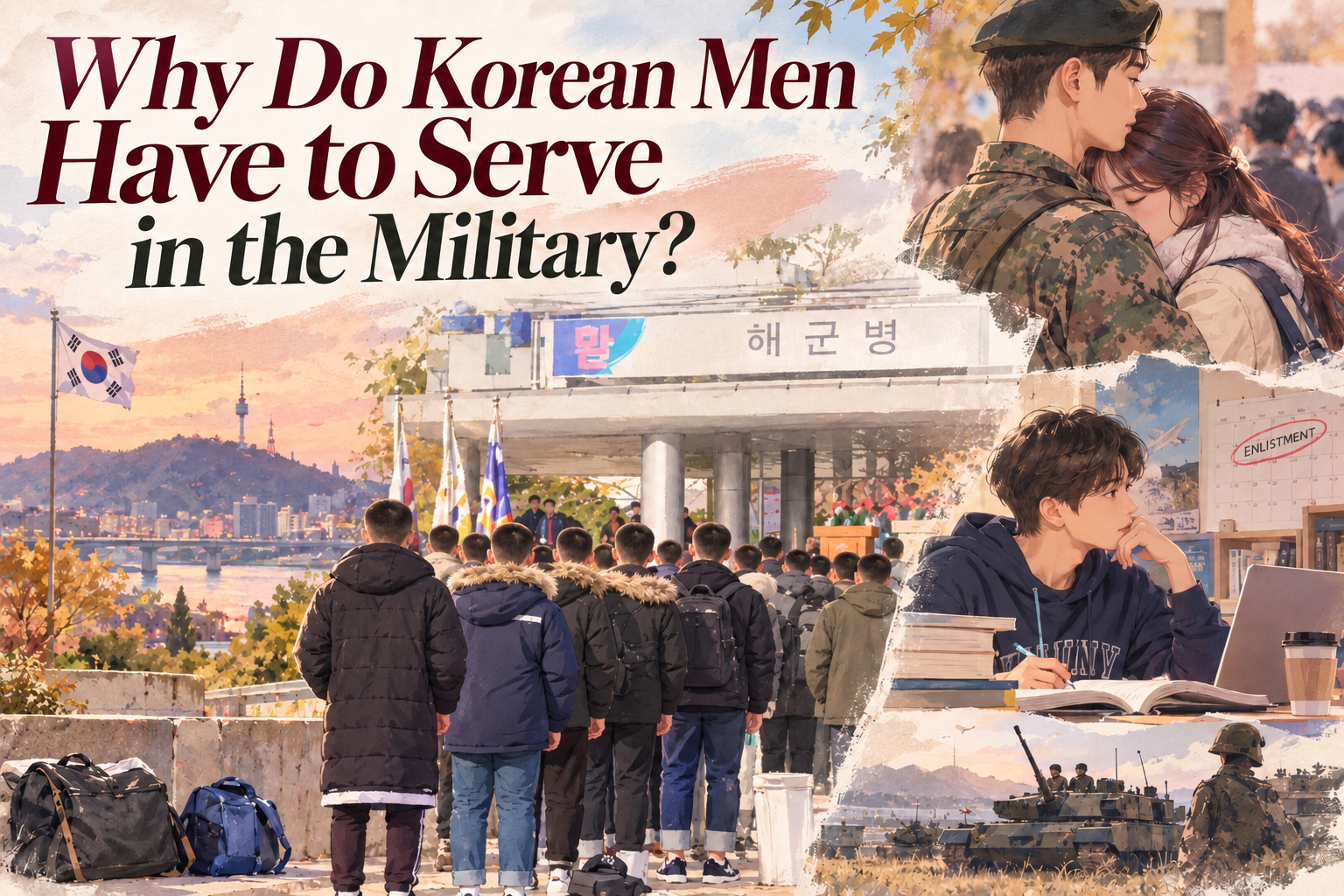
Why do Korean men pause college, careers, and even K-Pop activities for the military? Korean Military Service explains the real-life system behind K-Dramas.
Korean Military Service: Why Do Korean Men Have to Serve?
If you watch K-Dramas or follow K-Pop, you have probably heard the news that a favorite actor or idol is “enlisting in the military.” For international fans, it can seem surprising that a celebrity at the height of his career may suddenly disappear from public life for around a year and a half or longer. In South Korea, however, this is a normal part of life for many young men.
Under South Korea’s military service system, male citizens are generally subject to military duty. They undergo a physical examination and are classified according to their health and other conditions. Depending on the result, they may serve as active-duty soldiers, perform another form of service, or receive a different classification.
This is why saying “every Korean man goes to the army” is an oversimplification. Not every man serves as an active-duty soldier, and not everyone serves in the Army itself.
There are also special categories for certain athletes and artists. For example, athletes who win an Olympic medal by placing third or higher, or who win gold at the Asian Games, may qualify to serve as art and sports personnel rather than completing regular active-duty military service. This is sometimes described casually as a “military exemption,” but legally it is a different form of military service rather than simply having no obligation at all.
The subject often attracts public debate because military service affects such a large part of young Korean men’s lives. BTS is a famous example international fans may recognize. By June 2025, all seven members had completed their required forms of service before returning to full-group activities.
To understand why Korean Military Service exists, you also need to understand Korea’s security situation. The Korean War stopped with the 1953 Armistice Agreement, not a peace treaty formally ending the war. South and North Korea therefore remain technically divided under an armistice, and South Korea continues to maintain a conscription system.
For viewers from countries such as the United States or the United Kingdom, where the armed forces are mainly staffed by volunteers, military enlistment scenes in K-Dramas may feel unusually dramatic. In Korea, however, they reflect a reality that many families experience.
Depending on their branch, training, qualifications, and assignment, active-duty service members can work in many different roles, including operating military vehicles, working with missile systems, serving aboard naval vessels, or performing technical and administrative duties.
Korean Military Service and College Life in Korea
So when do Korean men usually serve?
There is no single required point in life when everyone must enlist. However, it is very common for university students to attend college for a year or two, take a leave of absence, complete their service, and then return to school.
That is why K-Dramas set on university campuses sometimes feature a boyfriend, classmate, or senior suddenly leaving for the military. You may also hear the Korean word bokhaksaeng(복학생), meaning a student who has returned to university after taking time away. For male students, military service is one of the most common reasons for this kind of break.
In everyday Korean life, questions like “When are you going to the military?” can come up naturally among male students in their late teens and early twenties.
As a Korean woman in my twenties, I have also grown up hearing friends, classmates, seniors, and younger students talk about enlistment and discharge. It does not usually feel like unusual news. It is simply one of the life stages that many people around me have experienced.
The length of Korean Military Service varies by branch for enlisted personnel. As of 2026, the required active-duty periods are:
Army : 18 months
Marine Corps : 18 months
Navy : 20 months
Air Force : 21 months
Although Air Force service is longer than Army service, some applicants still choose it because they prefer particular specialties, working conditions, or opportunities available within that branch. The Marine Corps also recruits applicants who specifically volunteer to join.
This means military service can affect the rhythm of university life in Korea in a way that may feel unfamiliar to international students. Two male classmates who enter university together may graduate in different years because one enlisted earlier than the other.
Why Korean Military Service Feels So Real in K-Dramas
Korean Military Service is not simply about spending 18 to 21 months in uniform. Enlistment can affect education, relationships, career plans, and family life.
Before entering the military, a university student may have to take a leave of absence. A couple may wonder how their relationship will change during the long separation. Someone preparing for a career may have to decide whether to serve before or after an internship, examination, or job search.
After discharge, young men also have to return to university or adjust again to civilian life.
That is why storylines about a boyfriend leaving for the military or a discharged soldier returning to college can feel completely ordinary to Korean viewers. What may look like a convenient K-Drama plot device to an international audience is often based on situations that happen in real life.
I have personally been interested in Korea’s military and security issues since I was young because my grandfather was a military officer. Because of that family background, I tend to see military service as part of a much larger story than simply “Korean men are required to join the military.”
South Korea’s security environment is also closely connected to the growth of its defense industry.
Korea has exported major defense systems such as the K2 Black Panther tank, K9 self-propelled howitzer, and FA-50 light combat aircraft. Poland, for example, has signed major contracts involving all three Korean systems.
Another important project is the KF-21, a South Korean-developed 4.5-generation fighter aircraft. Its development flight-testing program was successfully completed in January 2026 after approximately 1,600 test flights. The KF-21 later completed major development milestones during 2026.
These developments show that Korea’s military culture, conscription system, security environment, and defense industry are all connected to the realities of living on a divided peninsula.
Understanding Korean Military Service Makes K-Dramas Feel Different
For international viewers, military enlistment in a K-Drama can sometimes look like a dramatic storytelling device designed to separate a couple or create an emotional goodbye.
For Korean audiences, it is much closer to everyday reality.
A university student taking time off to enlist, parents worrying about their son’s first days in the military, a girlfriend waiting for her boyfriend, or a discharged soldier returning to campus are all familiar situations in Korean society.
Of course, Koreans do not all feel the same way about military service.
Some people see it as a period of responsibility, discipline, and personal growth. Others focus more on the disruption it can cause to education, careers, relationships, and plans during an important stage of young adulthood. For that reason, Korean Military Servicecontinues to be discussed and debated within Korean society as well.
So the next time a K-Drama character says, “I’m going to the military,” or mentions that he has just been discharged, the scene may mean more than it first appears.
Behind that short line is a much larger part of modern Korean life: the divided Korean Peninsula, conscription, university culture, family relationships, and the experiences of young people in their twenties.
Understanding Korean Military Service can therefore help you understand not only a K-Drama storyline, but also an important part of the real Korea behind the drama.
