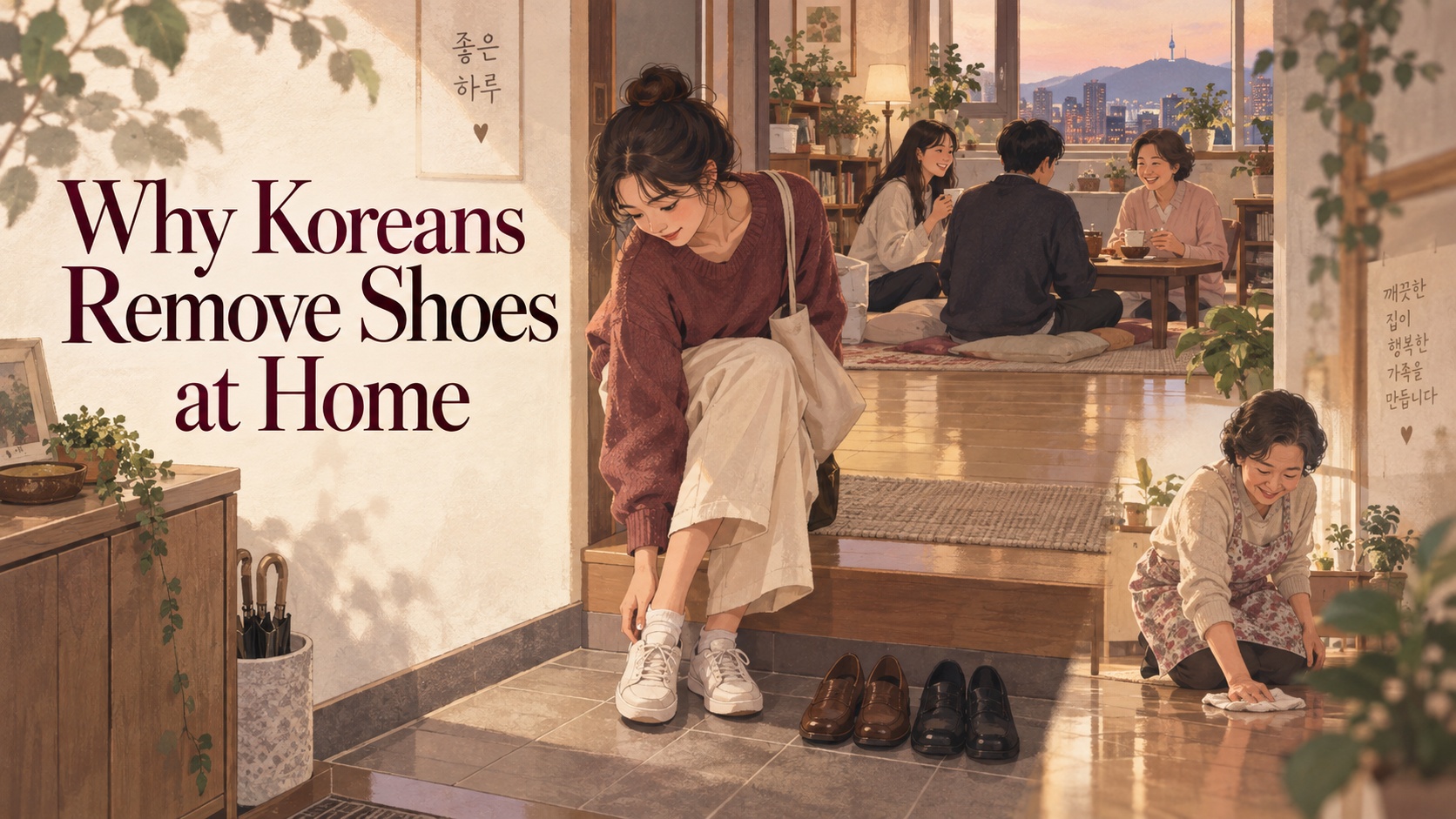
Why do Koreans Take Off Their Shoes at Home? Discover how ondol heating, floor-centered living, cleanliness, and everyday K-Drama scenes reveal this Korean habit.
Why Koreans Take Off Their Shoes at Home: The Floor Is More Than Just a Floor
If you watch K-Dramas, you may notice that characters almost always take off their shoes as soon as they step inside a home. International viewers might wonder, “Do they really have to take their shoes off even if they are only staying for a few minutes?”
For Koreans, the inside of a home is clearly separated from the outside world. The floor is not simply something people walk on. Koreans may sit on the floor to eat, watch TV, talk with family, or relax, while young children often play directly on it.
That is one reason Koreans Take Off Their Shoes at Home. Walking indoors with shoes covered in dust or dirt from outside would make the living space feel unclean.
Most Korean homes have an entrance area, or hyeongwan, where shoes are removed before stepping onto the raised indoor floor. Crossing that small boundary means moving from the outside world into a clean living space. Unlike entrances in many Western homes, the Korean hyeongwan often sits slightly lower than the main living area, clearly marking where outdoor shoes should be removed.
This is why a seemingly ordinary K-Drama scene in which a character quietly removes and arranges their shoes at the entrance actually reveals something important about everyday Korean life.
Ondol, Floor Living, and Korea’s Culture of Cleanliness
Another important reason Koreans Take Off Their Shoes at Home is Korea’s traditional floor-heating culture.
Ondol is Korea’s traditional heating system, developed over centuries in response to the country’s cold winters and distinct seasonal climate. Instead of heating only the air, traditional ondol warmed the floor itself. As a result, Koreans traditionally spent much of their daily lives sitting, eating, resting, and even sleeping close to the warm floor.
The floor therefore became part of the living space rather than simply a surface to walk across. Keeping it clean naturally became important. However, ondol is not the only reason Koreans remove their shoes. The custom also reflects long-standing ideas about cleanliness, household etiquette, and keeping outdoor dirt away from indoor living spaces.
Many Koreans also grew up hearing a familiar phrase when coming home in the evening: “Don’t go into your room yet. Wash your hands and feet first.” Older generations, especially grandmothers, were often known for sweeping and wiping floors until they practically shone.
I grew up hearing this kind of advice as well. It reflects a broader Korean habit of drawing a strong boundary between the cleanliness of the home and the dirt of the outside world.
Ondol remains an important part of Korean life today. During the 2018 PyeongChang Winter Olympics, international visitors and athletes attracted attention for enjoying Korea’s warm heated floors. Modern Korean homes now use boiler-based floor heating, while heated mats and hot-water mats have adapted the same desire for warmth to modern lifestyles.
Koreans Take Off Their Shoes at Home: How It Compares With Other Countries
The custom may feel unusual to viewers from places where wearing outdoor shoes inside the house is more common, including some households in the United States and Europe. Viewers from Japan and other cultures where shoes are also removed indoors may find the practice much more familiar.
What makes the Korean version particularly interesting is its close connection with heated floors and a long tradition of floor-centered living. Some Korean homes provide indoor slippers for guests, while others prefer socks or bare feet. Separate bathroom slippers are also common, especially because bathroom floors can get wet.
K-Dramas show this culture constantly without explaining it.
When someone visits another person’s home for the first time, they normally remove their shoes at the entrance. In some homes, the host may offer indoor slippers. In scenes where a character brings home a drunk friend or partner, they may even remove that person’s shoes before helping them farther inside.
Shoes can also become part of the storytelling. A character rushing out of the house may struggle to put on their shoes properly, turning a tiny everyday action into a funny or emotional moment.
These scenes may last only a few seconds, but they quietly show how Koreans Take Off Their Shoes at Home and how strongly the entrance functions as a boundary between public life and private space.

Conclusion
Taking off shoes before entering a Korean home is more than a rule of etiquette. It developed alongside ondol heating, floor-centered living, and a strong preference for keeping indoor spaces clean.
So the next time you see a character stop at the entrance in a K-Drama, pay attention to that small gesture. Removing shoes may seem insignificant, but it carries traces of Korean history, housing culture, family habits, and ideas about cleanliness.
It is one of those everyday details that can make a K-Drama scene feel ordinary to Koreans while revealing an entirely new layer of Korean culture to international viewers. And if you have ever wondered why Korean homes have such warm floors, the answer leads to another fascinating part of Korean history: ondol, Korea’s traditional floor-heating system.
Note from Rebecca:
Have a question about K-Dramas or Korean culture? Feel free to leave a comment below!