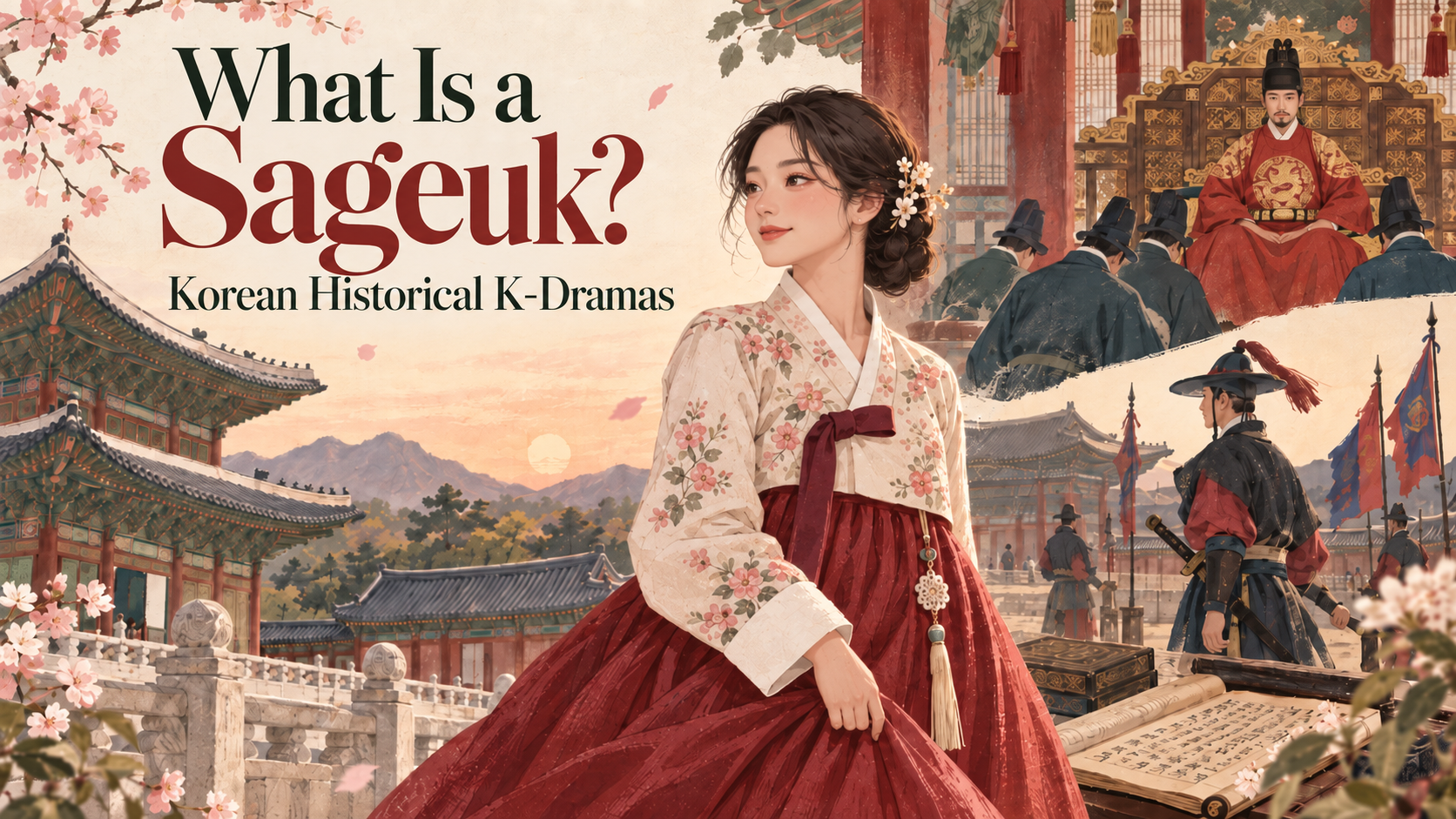
Are Korean historical dramas based on true events? Discover what sageuk means, how traditional and fusion sageuk differ, and how shows like Jewel in the Palace and Kingdomblend Korean history with fiction.
Royal palaces, colorful hanbok, scholars wearing wide-brimmed black hats, and warriors carrying swords. If you’re new to Korean historical dramas, these details might catch your attention right away. But just because a K-Drama features a king doesn’t mean everything in the story actually happened.
In Korea, dramas set in the past are commonly called sageuk (사극). One of the best ways to appreciate them is to recognize the difference between their historical settings and the stories created for television.
Two characters might wear similar traditional Korean clothing, yet one drama could follow the life of a real historical figure while another tells an entirely fictional story set in a royal palace.
What Is a Sageuk? Traditional vs. Fusion Korean Historical Dramas
The Korean word sageuk (史劇) refers to historical dramas, or dramatic works set in the past. Many Korean historical dramas take place during the Joseon Dynasty, which lasted from 1392 to 1910.
That’s why viewers often encounter kings and queens, crown princes, government officials, yangban (members of the traditionally privileged social class), and commoners living within a deeply hierarchical society. These familiar elements reflect the social and political systems of the time.
However, not every sageuk takes place in Joseon.
Jumong tells a story centered on the founding of Goguryeo, an ancient Korean kingdom. Six Flying Dragons explores the political upheaval of the late Goryeo period and the founding of Joseon. Historical K-Dramas can introduce viewers to many different periods of Korean history.
Traditional sageuk generally place greater emphasis on historical figures, documented events, and political conflicts. Fusion sageuk, on the other hand, combine historical settings with romance, mystery, fantasy, or modern storytelling techniques.
Netflix’s Kingdom is a good example of fusion sageuk.
The series draws on Joseon’s royal succession struggles and palace politics, but its outbreak of infected, monstrous creatures and the mysterious resurrection plant are fictional elements.
There’s one important distinction worth remembering: even traditional sageuk are not documentaries. A drama can feature real historical figures while inventing conversations, relationships, and details of how events unfolded.
Why Do Korean Historical Dramas Look So Different? The Meaning of Gat and Hanbok
One of the most memorable visual details in Kingdom is the large black hat worn by men during the Joseon period.
This traditional Korean hat is called a gat (갓).
A gat wasn’t simply a hat that protected someone from the sun. It could also communicate social standing, proper etiquette, and the wearer’s position within society.
The familiar black version, known as a heungnip (흑립), was traditionally crafted using materials such as bamboo and horsehair. But not every gat was black.
White hats were associated with mourning, while certain military officials wore red hats. Depending on the period and circumstances, a character’s headwear could offer clues about their position or the situation they were facing.
Hanbok, Korea’s traditional clothing, also carried social meaning.
A court woman’s hairstyle and accessories or a government official’s formal robes could indicate social status and responsibilities. Clothing conventions changed over time, however, so it would be inaccurate to imagine everyone in Joseon wearing exactly the same styles throughout the dynasty.
Understanding these details can change how you watch a sageuk.
A character bowing deeply or an official speaking before the king might look like a simple moment of palace etiquette. Yet these gestures often reflect the social hierarchy and political values underlying the story.
Neo-Confucianism played an important role in Joseon’s political and social order. Officials were expected to serve the monarch, but they could also challenge royal decisions and attempt to restrain the king’s authority.
That means a confrontation between a king and his ministers isn’t necessarily just a personal disagreement. It may represent a conflict over political principles, responsibilities, and the proper exercise of power.
Did This Really Happen? Understanding History and Fiction in Sageuk
Jewel in the Palace, also known as Dae Jang Geum, offers a useful example of how historical fact and fictional storytelling can coexist.
Jang Geum was a real female medical practitioner whose name appears in historical records from the reign of King Jungjong of Joseon. However, not every detail of her childhood, personal relationships, or journey depicted in the drama can be verified through those records.
Kingdom takes a different approach.
Its Crown Prince Lee Chang and the zombie outbreak are fictional creations, rather than documented events in Joseon history. The drama uses elements of historical palace politics and royal succession to build an entirely new story.
Once you understand this distinction, you can begin asking more interesting questions as you watch.
Did this person really exist? Was the event recorded in historical documents? Do the costumes and buildings belong to the period being portrayed?
In Korea, these questions can sometimes lead to serious debates about historical accuracy.
Viewers may criticize a drama when it significantly changes the actions of real historical figures or alters important historical events. Costumes, military equipment, architecture, cultural practices, and even background props can come under close scrutiny.
One particularly sensitive issue arises when viewers believe a production has used Chinese- or Japanese-style visual elements in ways that misrepresent Korean history.
In 2021, the historical fantasy series Joseon Exorcist became a notable example. It faced widespread criticism over its portrayal of real historical figures and the inclusion of Chinese-style props and food in its Joseon setting. Broadcaster SBS canceled the series after just two episodes.
That doesn’t mean every Korean viewer expects perfect historical accuracy. Many enjoy the creative freedom of fusion sageuk, especially when a production makes its fictional premise clear. Historical sensitivity also doesn’t mean that every visual similarity between Korean and neighboring cultures is necessarily an error.
Still, debates like these show why history can matter so much to the way sageuk are received in Korea.
If you’d like to explore some of that history beyond the screen, Gwanghwamun Square in Seoul is an interesting place to start.
The square features statues of King Sejong the Great and Admiral Yi Sun-sin, two prominent figures in Korean history.
King Sejong, a ruler of Joseon, oversaw the creation of Hunminjeongeum, the original writing system that developed into today’s Hangul. Admiral Yi Sun-sin is remembered for his role in defending Joseon during the Japanese invasions of Korea in the late 16th century.
It’s one way to encounter names and historical figures familiar from Korean period dramas in a real place in modern Seoul.
Seeing More Than Costumes and Palaces
The appeal of sageuk isn’t simply that these dramas recreate the past. It’s also that they bring historical settings and creative storytelling together to explore themes that still resonate today.
The next time you watch a Korean historical drama, look beyond the beautiful palaces, elaborate hanbok, and romantic storylines. Pay attention to what characters wear, how they address one another, and the political relationships shaping their decisions.
And consider one question: Did this scene grow out of actual history, or was it born from the writer’s imagination?