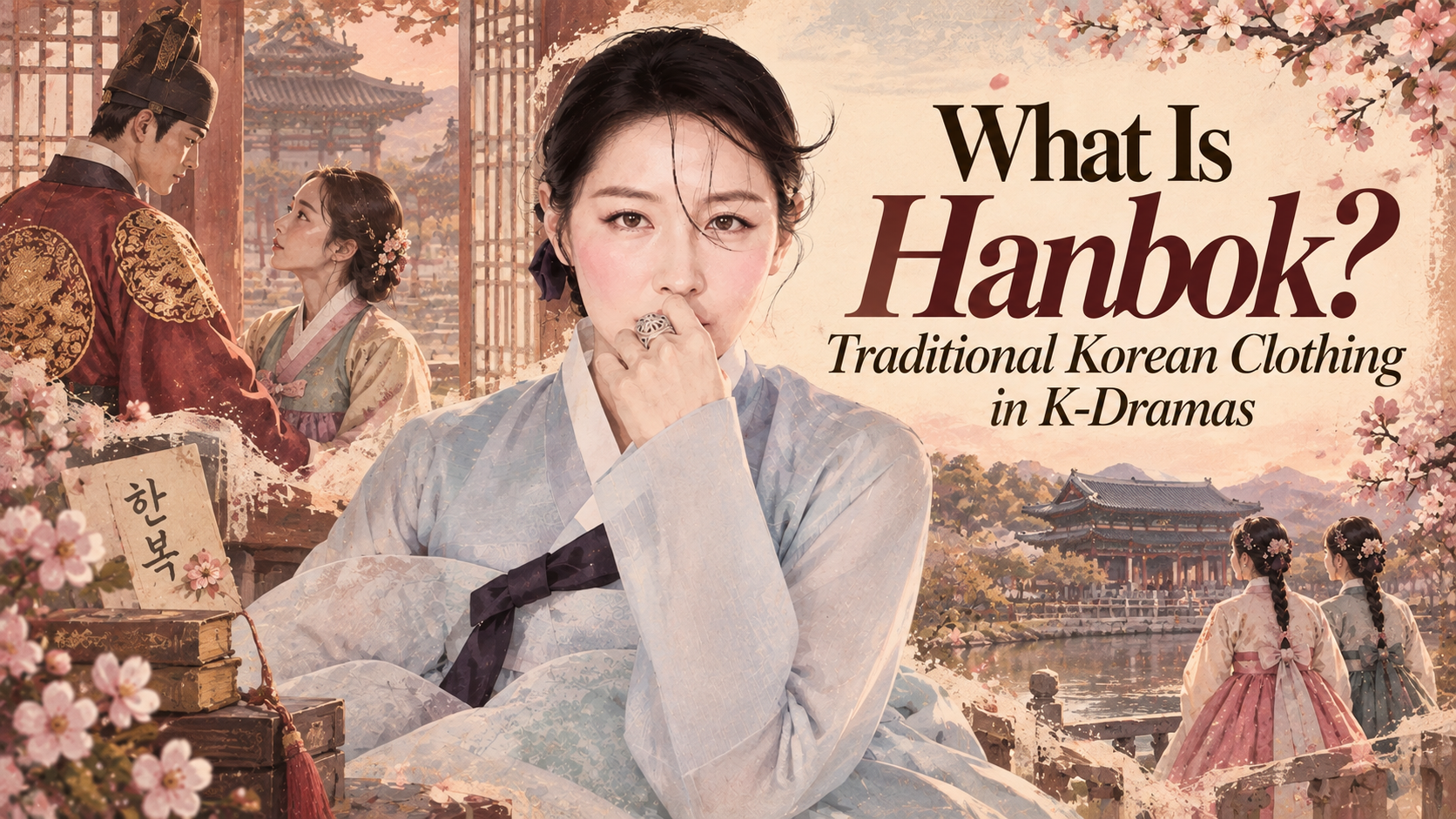
What is Hanbok in K-Dramas, and why does it look so distinctive? Discover its shape, colors, historical roots, everyday use in Joseon Korea, and how this traditional clothing still appears at weddings, holidays, and cultural events today.
What Is Hanbok in K-Dramas?
If you are watching a Korean historical drama for the first time, you may wonder whether Koreans really wore those wide skirts, short jackets, and flowing sleeves in everyday life.
Hanbok is the traditional clothing of the Korean people. Its early forms can be seen in Goguryeo tomb murals dating from roughly the 4th to 6th centuries, as well as in artifacts from the Silla and Baekje kingdoms. Over many centuries, the style of hanbok changed according to period, social status, gender, and season, but its basic structure remained remarkably consistent.
For women, the most recognizable combination is the jeogori, a short jacket, worn with a long skirt called a chima. Men traditionally wore a jeogori with trousers called baji, often adding outer garments such as a durumagi.
While many traditional Western clothes were designed to emphasize the shape of the body, traditional Korean clothing generally placed greater emphasis on flowing lines, space, and movement. This is one reason Hanbok in K-Dramas looks especially graceful when characters walk through palace courtyards or move slowly across a room. The movement of the fabric itself helps create the atmosphere of the scene.

Hanbok in K-Dramas and Korea’s Tradition of White Clothing
Historical K-Dramas often show kings, queens, and members of the royal court wearing vivid red, blue, gold, and other rich colors. Everyday clothing worn by ordinary people, however, was generally much simpler.
Koreans historically had a strong preference for white clothing, which contributed to the well-known expression baegui minjok, often translated as “the white-clad people.” This preference is particularly interesting because white clothing could easily become dirty during farming and other forms of daily work, yet the tradition continued for generations.
That does not mean Koreans always wore only white. Clothing colors varied according to period, region, social class, occasion, and personal circumstances. Still, white became one of the most recognizable features of traditional Korean everyday dress.
I also remember wearing hanbok when I was young. During Seollal, the Lunar New Year, and Chuseok, families would sometimes take traditional clothes out of the wardrobe and wear them when visiting relatives. In winter, I remember wearing several layers underneath my hanbok. It kept me warm, but as a child, I also found it surprisingly hot and uncomfortable.
That childhood memory reminds me that the beautiful clothing we see in historical dramas was not created only for visual beauty. It was also real clothing shaped by Korea’s climate, seasons, and everyday way of life.
Do Koreans Still Hanbok Today?
In the past, it was common for people preparing for marriage to purchase their own hanbok. Although this custom has become less common, hanbok is still visible at Korean weddings. The mothers of the bride and groom often wear elegant traditional clothing while greeting guests and participating in the ceremony.
Even into the 2000s, it was more common than it is today for families to wear hanbok during major traditional holidays such as Seollal and Chuseok. Today, fewer Korean families wear it regularly at home, which can feel a little unfortunate considering how closely the clothing is connected to family celebrations and Korean tradition.
However, hanbok has certainly not disappeared. It remains important at traditional weddings, a baby’s first-birthday celebration known as doljanchi, cultural events, festivals, performances, and palace experiences. Around Seoul’s historic palaces, it is also common to see both young Koreans and international visitors renting hanbok and exploring the palace grounds.
This is why Hanbok in K-Dramas can appear in very different settings. In modern dramas, it may appear at weddings or family celebrations. In historical dramas, clothing can function almost like a visual language, suggesting a character’s rank, role, age, relationship, or social position before anyone says a word.
Final Thoughts
Hanbok in K-Dramas is much more than beautiful costume design. Behind its colors, shapes, and flowing silhouettes are centuries of Korean history, changing social customs, seasonal life, family traditions, and ideas about status and identity.
Koreans no longer wear hanbok as everyday clothing, but the tradition continues through weddings, cultural events, palace visits, celebrations, and, of course, K-Dramas.
The next time you watch a sageuk, try looking beyond the characters’ faces. Pay attention to the color of the clothing, the shape of the sleeves, the layers, and who is allowed to wear what. You may discover that the costume is quietly telling you something about Korean culture that the dialogue never explains.
Note from Rebecca:
Have a question about K-Dramas or Korean culture? Feel free to leave a comment below!