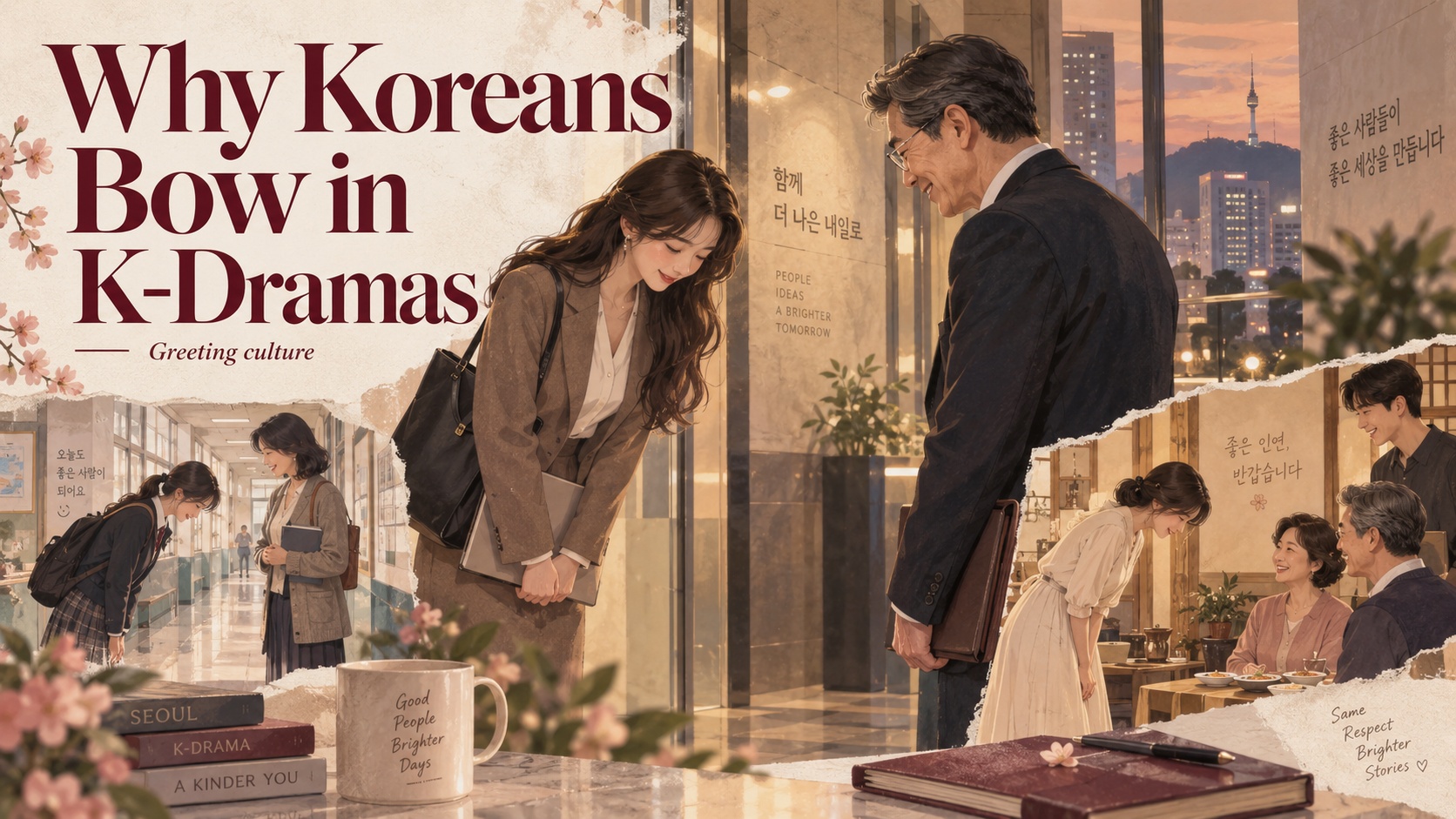
Why do Koreans bow so often in K-Dramas? Explore Korean greeting culture, from Confucian traditions and age hierarchy to workplace etiquette and everyday life.
Korean Greeting Culture: Why Do Koreans Bow So Often?
International K-Drama viewers may wonder, “Why do Koreans bow almost every time they meet someone?” Characters bow to their bosses, teachers, older people, customers, and even neighbors. In Korea, a greeting often means more than simply saying “hello.” It is also a small but visible way of showing respect.
When meeting someone for the first time, speaking to an older person, or greeting a superior at work, Koreans commonly combine words such as annyeonghaseyo with a slight bow. This does not mean everyone bows deeply at a 90-degree angle. Among close friends, a small nod, a wave, or a casual “annyeong” may be enough. Deeper bows are more likely in formal situations or when expressing strong gratitude or apology.
In many Western cultures, a handshake, hug, or cheek kiss can express friendliness. Korean greeting culture, by comparison, often communicates respect while maintaining more physical distance. The depth of the bow, tone of voice, and choice of words can all quietly reveal the relationship between two people.
Korean Greeting Culture: Why Do Age and Status Matter?
Part of Korean greeting culture can be understood through Korea’s long Confucian tradition. One traditional idea is jangyuyuseo, which emphasizes an appropriate order and respect between older and younger people. During the Joseon Dynasty, age, family position, and social status strongly influenced etiquette and forms of speech. Modern Korea is far less rigid, but traces of these customs remain in everyday interactions.
A newly hired employee may give a small bow and say annyeonghaseyo when passing a manager in the hallway. When Koreans first enter the workplace, they are often taught to acknowledge senior colleagues with a slight bow even if they see them several times a day. Greeting others politely can also be seen as a sign of an engaged and positive attitude at work, which is why senior employees may pay attention to how well younger or junior colleagues greet others.
It is also completely natural for students to greet their teachers. In an apartment elevator, people may give a small bow when they meet an older neighbor. Even if the other person does not respond very enthusiastically, greeting them first is generally considered polite and well-mannered in Korea.
People in the United States and Europe also show respect to teachers, senior colleagues, or strangers, but Korean relationships can be more visibly reflected through language and body movement. Korean has different speech levels, including polite and casual forms. This is why the same character in a K-Drama may joke casually with a friend one moment, then immediately change their vocabulary, tone, and posture when a senior executive enters the room.
Korean Greeting Culture in K-Dramas: A Silent Clue to Relationships
Once you understand Korean greeting culture, greeting scenes in K-Dramas become surprisingly informative. A junior employee may bow politely to a company chairman but wave casually at a close coworker. Someone meeting their romantic partner’s parents for the first time may bow more carefully than usual, while a job applicant may greet interviewers with a formal bow before taking a seat.
This becomes especially noticeable in office dramas and chaebol-family stories. A protagonist standing respectfully before a chairman, a junior greeting a sunbae first, or an employee bowing deeply while apologizing can tell viewers about hierarchy without a single line of explanation.
Even refusing to greet someone can carry meaning. If two people normally acknowledge each other but one suddenly walks past without a word or a nod, Korean viewers may immediately read the moment as tension, disrespect, anger, or emotional distance.
Western dramas can use a rejected handshake in a similar way. In K-Dramas, whether a character bows—and how deeply—can function like silent dialogue. It tells you who holds seniority, who is trying to be respectful, and sometimes whether a relationship has suddenly changed.

Understanding a Korean Bow Helps You Read a K-Drama
The next time a K-Drama character gives a quick nod or bends deeply at the waist, it is worth looking beyond the simple act of saying hello. That small movement can communicate age difference, professional status, familiarity, gratitude, apology, or respect.
The heart of Korean greeting culture is not about bowing as deeply as possible. It is about adjusting your behavior to the person and situation in front of you. A casual nod between friends and a careful bow to a partner’s parents may look similar to an unfamiliar viewer, but Koreans immediately recognize that they carry different meanings.
Once you begin watching these details, K-Dramas can become easier to read. The way characters greet each other may reveal who is senior, how close they are, and even whether their relationship is improving or falling apart.
A Korean bow lasts only a second, but in a K-Drama, it can say much more than “hello.”
Note from Rebecca:
Have a question about K-Dramas or Korean culture? Feel free to leave a comment below!