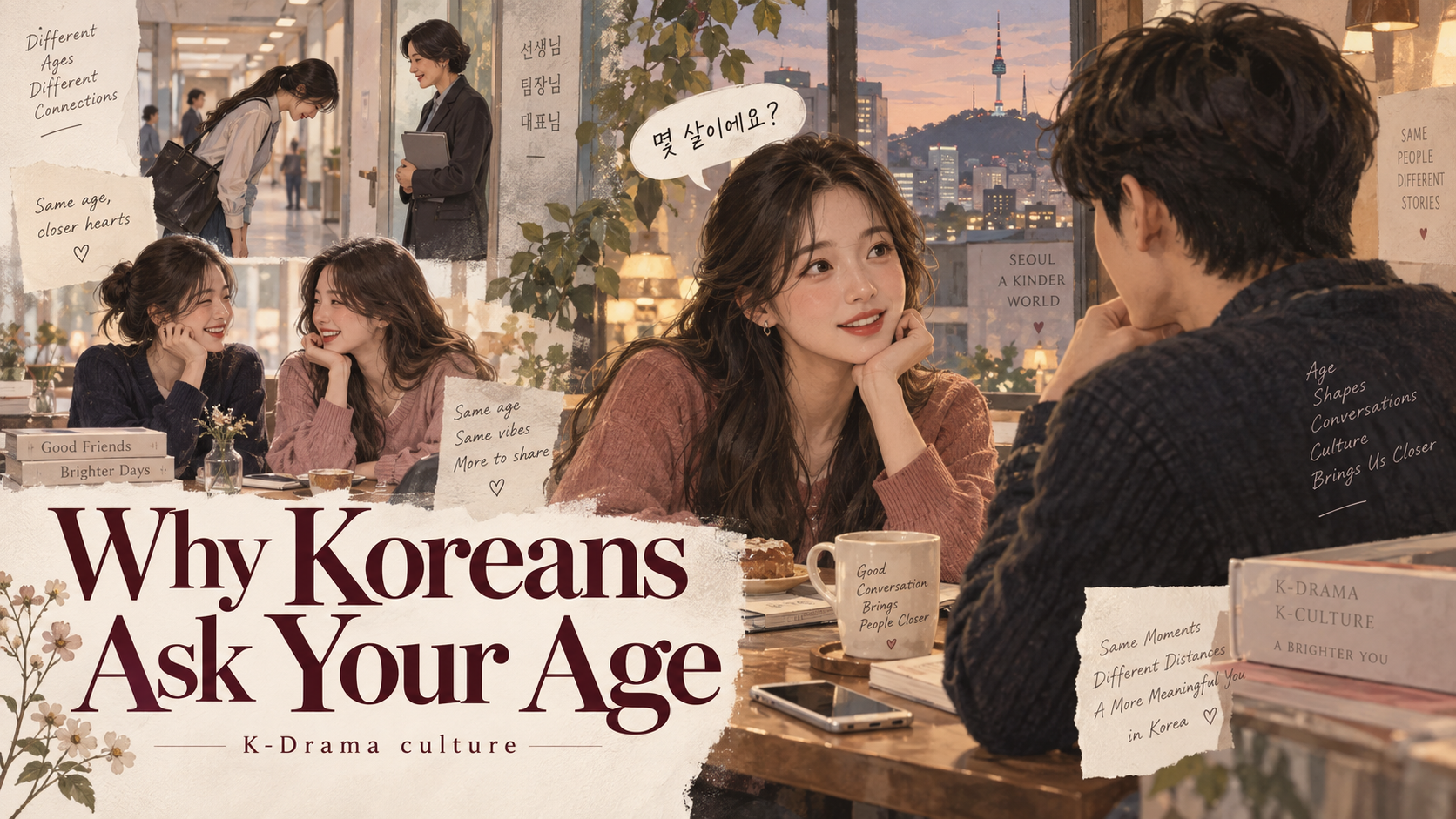
Why do Koreans ask your age so soon after meeting? Korean age culture shapes honorifics, speech levels, social etiquette, and relationships in everyday life and K-Dramas.
Why Do Koreans Ask Your Age So Soon?
International K-Drama viewers may be surprised when two characters meet for the first time and, shortly after exchanging names, one asks, “How old are you?”
In the United States or parts of Europe, age can be considered fairly personal information, so asking someone directly may sometimes feel intrusive. In Korea, however, the question often serves a different purpose.
Knowing someone’s age helps people understand how to speak to each other and which form of address may feel natural. If someone is older, a younger person may continue using polite speech or use terms such as oppa, unnie, hyung, or noona, depending on gender and relationship.
If two people discover that they are the same age, they may eventually agree to speak more casually with each other.
This is one reason Korean age culture can be confusing to international viewers. Asking about age is not always simple curiosity. It can be a way of figuring out the social language of a new relationship.
Where Does Korean Age Culture Come From?
Korean age culture has historical roots in Korea’s long Confucian tradition.
During the Joseon Dynasty, age, family position, and social rank strongly influenced etiquette and forms of speech. Relationships between older and younger people were more clearly structured than they are today.
One traditional idea connected with this background is jangyuyuseo, which emphasizes appropriate order and respect between older and younger people. It does not mean that younger people must blindly obey anyone older than them. Instead, it helps explain why age differences have traditionally influenced manners and communication.

Modern Korea is far less rigid than Joseon-era society, but traces of these customs remain in everyday language.
At work, job title may matter more than actual age. Among friends, however, even a one- or two-year age difference can affect what people call each other.
So in modern Korea, age is not an absolute rule. It is one of several factors that help people decide how formal, familiar, or respectful a relationship should be.
How Korean Age Culture Changes Relationships in K-Dramas
One of the most interesting places to notice Korean age culture is in K-Dramas.
Two characters may begin by speaking politely to each other. Then they discover that they are the same age and one asks, “Should we speak casually?”
That simple moment can signal that the emotional distance between them is shrinking.
Another common scene happens when a woman begins calling a slightly older man oppa. She may previously have called him sunbaenim, “Mr. Kim,” “Team Leader,” or another formal title. Once she changes the way she addresses him, Korean viewers may immediately recognize that their relationship has become more personal.
Workplace dramas can be even more complicated. A younger manager may still receive polite speech from older employees because professional rank matters. Meanwhile, an older employee with a lower position may need to navigate both age hierarchy and workplace hierarchy at the same time.
This is one major difference from English-speaking cultures. English usually uses the same word, “you,” regardless of age or status. Korean, however, can communicate relationships through speech levels, titles, names, and forms of address.
Perhaps because Korean has such a well-developed system of honorifics and polite speech, switching to casual speech can play an important role in building relationships in Korea. In social relationships where people are not yet very close, or when two people are dating and gradually becoming closer, agreeing to speak casually can help reduce emotional distance and create a greater sense of intimacy. This seems to be especially common among younger people.
However, suggesting casual speech without a shared sense of closeness can sometimes come across as rude or make the other person uncomfortable. That is why Koreans usually pay attention to the situation and the other person’s reaction before carefully asking whether it would be okay to “drop the honorifics” and speak more casually.
That is why a simple age question in a K-Drama can quietly mean, “How should we speak to each other from now on?”
Final Thoughts
At first, Korean age culture may seem unusual to international viewers. But asking someone’s age can reveal much more than a number.
Age can influence titles, speech levels, manners, and the amount of familiarity between two people.
So when a K-Drama character asks someone’s age and then changes from formal speech to casual speech—or starts using words such as oppa, unnie, hyung, or noona—pay attention.
The scene may be showing that their relationship has changed.
Once you begin noticing how characters address each other before and after they learn each other’s age, Korean conversations in K-Dramas become much easier to understand.
Note from Rebecca:
Have a question about K-Dramas or Korean culture? Feel free to leave a comment below!