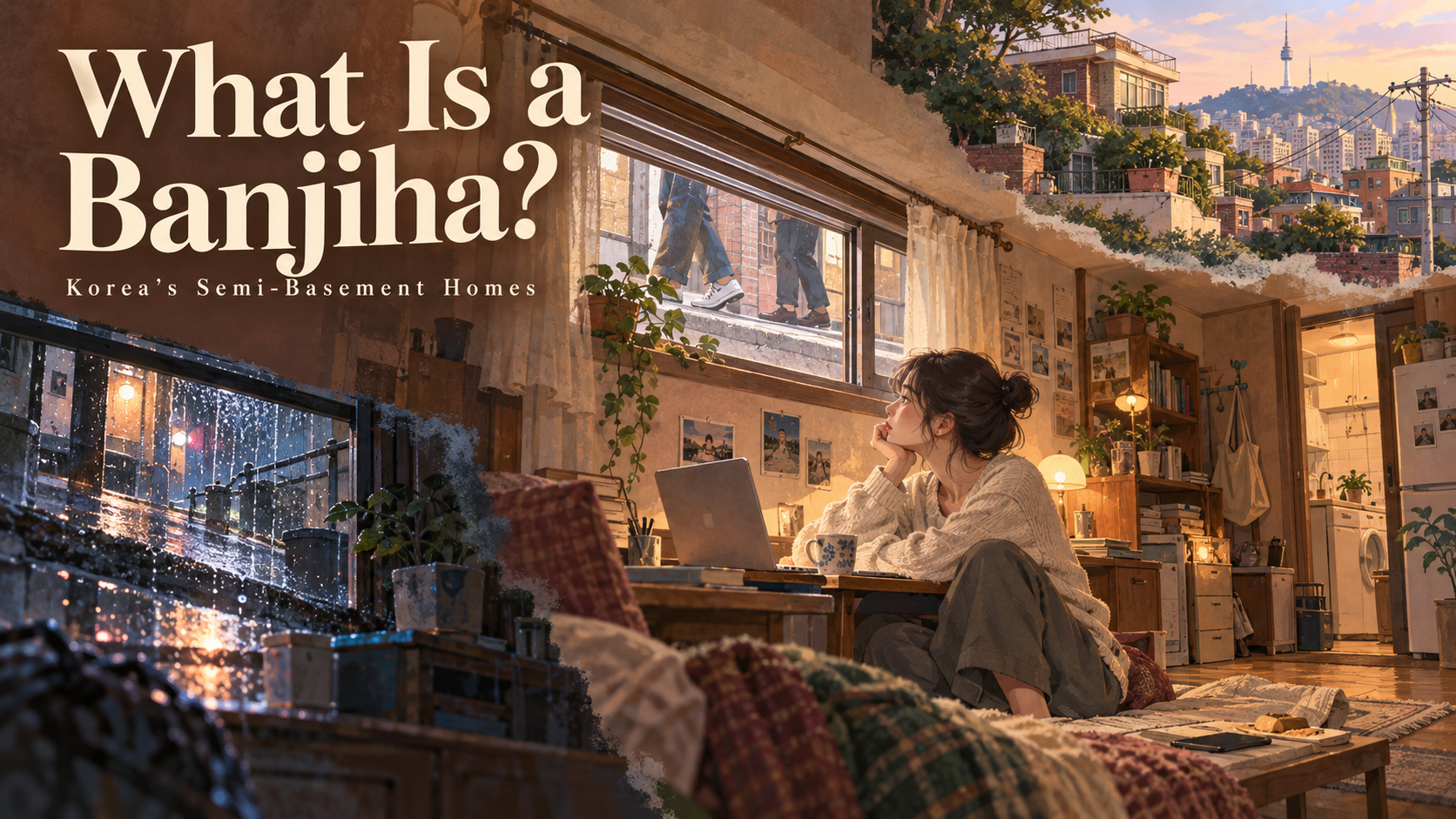
The semi-basement home in Parasite is a real part of Korean housing culture. Discover why Banjiha homes exist, their history, and what they reveal about life in Korea.
What Is a Banjiha? A Home That’s Half Underground
Have you ever watched the Korean movie Parasite?
In the film, the Kim family lives in an unusual apartment with small windows overlooking the street. Through those windows, they can see the legs of people walking past, while very little sunlight reaches their home.
This type of apartment is called a Banjiha (반지하) in Korean.
A Banjiha is a semi-basement apartment, meaning part of the home sits below ground level while the rest is above it.
Of course, semi-basement housing isn’t unique to Korea.
In New York, you’ll find basement apartments and garden apartments, some of which are partially below street level. London also has basement flats, often located beneath older residential buildings.
However, Korea’s Banjiha homes have a distinctive history connected to national security concerns and the country’s rapid urbanization.
Walking through older residential neighborhoods in Seoul, you may notice small windows positioned just above the sidewalk. Beneath what looks like an ordinary house, someone may be living in a completely separate home.
Banjiha apartments are generally more affordable than apartments on higher floors, making them an option for people looking to save on rent.
However, they also have disadvantages, including limited sunlight, poor ventilation, humidity, and the risk of flooding during heavy rainfall.
Why Does Korea Have Banjiha Homes? From Air-Raid Shelters to Apartments
Surprisingly, the history of Banjiha housing is closely connected to the threat of war.
In January 1968, a group of North Korean commandos attempted to attack the South Korean presidential residence, known as the Blue House. The incident heightened tensions between North and South Korea.
At the time, the South Korean government was concerned about the possibility of another military conflict.
In 1970, building regulations required certain buildings to include underground spaces that could serve as air-raid shelters during wartime.
These spaces were not originally intended to be homes.
However, things began to change during the 1970s and 1980s as South Korea experienced rapid industrialization and economic growth.
Large numbers of people moved from rural areas to Seoul in search of jobs and better opportunities. As the city’s population increased, affordable housing became increasingly difficult to find.
Landlords began converting underground storage rooms and boiler rooms into rental apartments. For people who couldn’t afford more expensive housing, these spaces became an alternative.
Changes to building regulations in 1975 and the early 1980s gradually eased restrictions on using basements as living spaces, helping Banjiha housing become more widespread.
This type of housing became especially common in Seoul and its surrounding metropolitan area, where population growth and housing demand were particularly intense.
Although semi-basement homes also exist elsewhere in Korea, they never became as widespread in many other cities as they did in Seoul.
As someone living in Korea, I find it fascinating that even the design of an ordinary residential building can reveal traces of the country’s history.
What looks like a simple apartment building today may reflect both the security concerns of the past and the dramatic economic changes Korea experienced over just a few decades.
Banjiha in Parasite and K-Dramas: How Housing Reveals Social Class
In Parasite, the Banjiha apartment is much more than just a filming location.
The Kim family lives in a cramped semi-basement apartment below street level, while the wealthy Park family lives in a spacious, sun-filled house on higher ground.
The contrast between these homes visually represents the economic inequality between the two families.
One of the film’s most memorable moments comes during a night of heavy rain.
For the Park family, the rain is little more than a temporary inconvenience, even leaving their garden looking refreshed.
For the Kim family, however, the same rainfall becomes a disaster that floods their home and threatens everything they own.
The contrast is striking: the same rain can be a minor inconvenience for one family and a life-changing disaster for another.
Interestingly, this use of architecture to represent social class isn’t unique to Korean storytelling.
In British period dramas, grand upper floors occupied by wealthy families often contrast with the downstairs spaces where servants worked.
Similarly, Parasite uses the physical difference between high and low spaces to communicate differences in social status.
K-Dramas also sometimes use small studio apartments, rooftop rooms, and semi-basement homes to show characters struggling financially or trying to establish independent lives.
However, it’s important not to assume that everyone living in a Banjiha apartment is poor.
People may choose these homes for various reasons, including lower rent, convenient locations, or personal circumstances.
Movies and dramas often dramatize real housing conditions, using the places where characters live to help audiences understand their lives and challenges.
Closing: Banjiha Is More Than Just a Basement
Banjiha apartments were not originally created as housing for people with limited incomes.
They began as underground spaces intended partly for wartime protection, but rapid industrialization and Seoul’s housing shortage gradually transformed them into residential apartments.
Living in Korea, when I notice the small windows of semi-basement homes in older neighborhoods, I’m reminded that these buildings are more than just aging houses.
They are part of the history of how Korean society has changed.
That’s also why the Banjiha apartment in Parasite carries so much meaning.
A home is more than simply a place to sleep. It can also reflect a person’s financial circumstances, daily experiences, and position within society.
The next time you spot a semi-basement apartment in a K-Drama or Korean movie, think about the history and everyday lives hidden behind those little street-level windows.