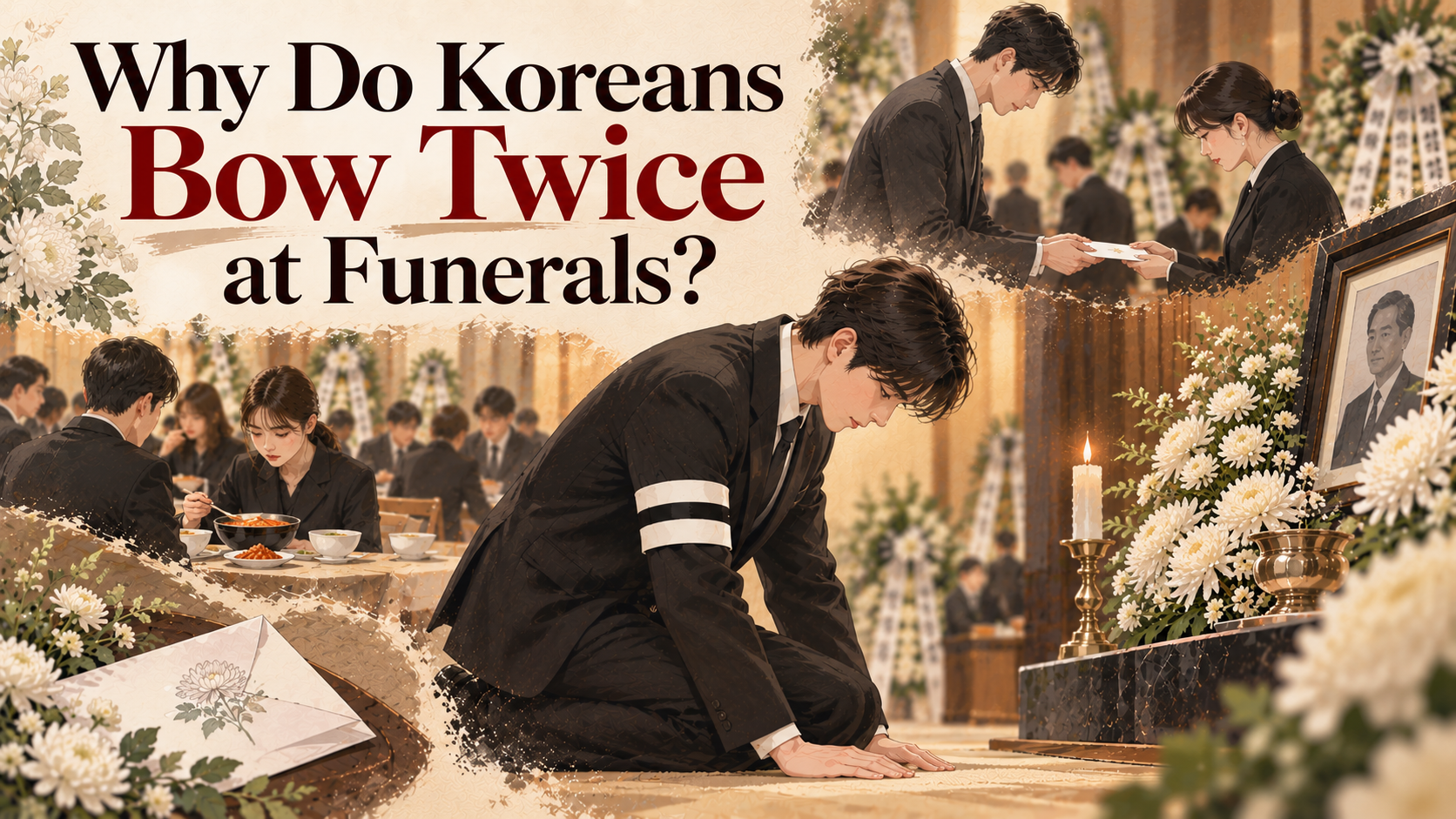
Why do Koreans bow twice at funerals? Discover Korean funeral etiquette seen in K-Dramas, from two bows and condolence money to funeral food, three-day funerals, and changing burial traditions.
Korean Funeral Etiquette: Why Do Koreans Bow Twice?
If you have watched a funeral scene in a K-Drama, you may have noticed something unusual. Mourners dressed in black approach a portrait of the deceased, kneel down, and bow deeply—not once, but twice. For viewers from cultures where a moment of silence, flowers, or a simple nod is more common, the ritual can be surprising.
In Korea, bowing is more than a way to say hello. It is a traditional expression of respect, and Korean funeral etiquette has specific customs for honoring the deceased. At many funerals, mourners bow twice before the portrait of the deceased. They then turn toward the chief mourners, usually close family members, and exchange a bow or offer words of condolence.
Traditional Korean ideas about numbers are sometimes used to explain this custom. In older East Asian thought, odd numbers were associated with yang (양, 陽) and even numbers with yin (음, 陰). Yang was associated with life and the living, while yin was associated with death and the deceased. The practice of making two bows to the deceased has often been understood within this broader symbolic tradition.
These customs also developed alongside Korea’s Confucian mourning traditions. Not every Korean funeral follows exactly the same ritual, however. At Christian funerals, for example, mourners may pray or stand in silence instead of bowing. So when a K-Drama character silently makes two deep bows before a portrait, the gesture is not simply a greeting. It is a formal farewell and an expression of respect for someone who has died.
Korean Funeral Etiquette: Why Do People Give Money and Eat Together?
Another detail that can puzzle international K-Drama viewers is the white envelope. Why do guests arrive at a funeral, hand over an envelope of money, and then sit down for a meal?
Giving condolence money is an important part of Korean funeral etiquette. Mourners usually bring money in a plain envelope and give it to the bereaved family. Traditionally, this helps the family with funeral expenses while also expressing sympathy and solidarity. In some ways, it parallels the Korean custom of giving congratulatory money at weddings.
Food is another important part of the experience. After paying their respects, visitors are usually offered a meal. They may sit together, eat, talk about the deceased, and spend time with the bereaved family. This is why K-Drama funeral scenes often show tables filled with rice, side dishes, soup, and especially yukgaejang, a spicy beef soup commonly associated with funeral meals. Koreans even sometimes joke that yukgaejang somehow tastes especially good at a funeral as they get older.
For a long time, weddings and funerals in Korea have been more than private family events. They have also been occasions when social relationships are maintained and acknowledged. This is one reason K-Drama funeral halls may be lined with large condolence flower arrangements bearing the names of companies, colleagues, organizations, or acquaintances.
In the past, these displays could become quite elaborate. Today, however, more families are choosing smaller and simpler ceremonies centered on close family members. The scale may be changing, but offering comfort and sharing the burden of loss remain at the heart of the tradition.
Korean Funeral Etiquette: Three-Day Funerals and Changing Burial Traditions
There is also a reason funeral halls sometimes appear across several episodes or scenes in a K-Drama. A common modern Korean funeral is known as a sam-il-jang (삼일장), literally a “three-day funeral.” Family members remain at the funeral hall while relatives, friends, coworkers, and acquaintances visit to pay their respects before the final procession and funeral rites.
The way Koreans lay the deceased to rest, however, has changed dramatically. Burial was once much more common in Korea. Around the beginning of the 2000s, cremation became increasingly widespread, and today many families choose cremation followed by placing the ashes in a columbarium or choosing a natural burial, including tree burials.
My own family traditions show how old rituals can continue even as Korean society changes. When my family performs jesa, a traditional memorial rite for ancestors, we pour alcohol into a ritual cup in three separate pours and rotate the cup clockwise three times. Details like these can differ from family to family, so there is no single ritual that every Korean household performs in exactly the same way.
Still, some elements of Korean funeral etiquette, including the familiar two bows to the deceased, have remained recognizable across generations. That is what makes funeral scenes in K-Dramas especially interesting: inside a modern hospital funeral hall, you can often see centuries-old ideas about respect, family, death, and remembrance continuing alongside contemporary Korean life.
Final Thoughts: Understanding Korean Funeral Etiquette in K-Dramas
The next time a funeral scene appears in a K-Drama, look closely. The two deep bows before the portrait, the white envelope of condolence money, the tables of food, and the visitors staying with the bereaved family are not simply background details. Together, they reveal how Koreans traditionally express respect for the dead and share grief with those left behind.
Korean funeral customs continue to change. Cremation and natural burials have increasingly replaced traditional burial, and some families now prefer smaller, more private funerals over large ceremonies. Yet the desire to give the deceased a respectful farewell remains central to Korean funeral etiquette.
Once you understand what these small gestures mean, a K-Drama funeral scene can tell you much more than its dialogue alone.
Note from Rebecca:
Have a question about K-Dramas or Korean culture? Feel free to leave a comment below!