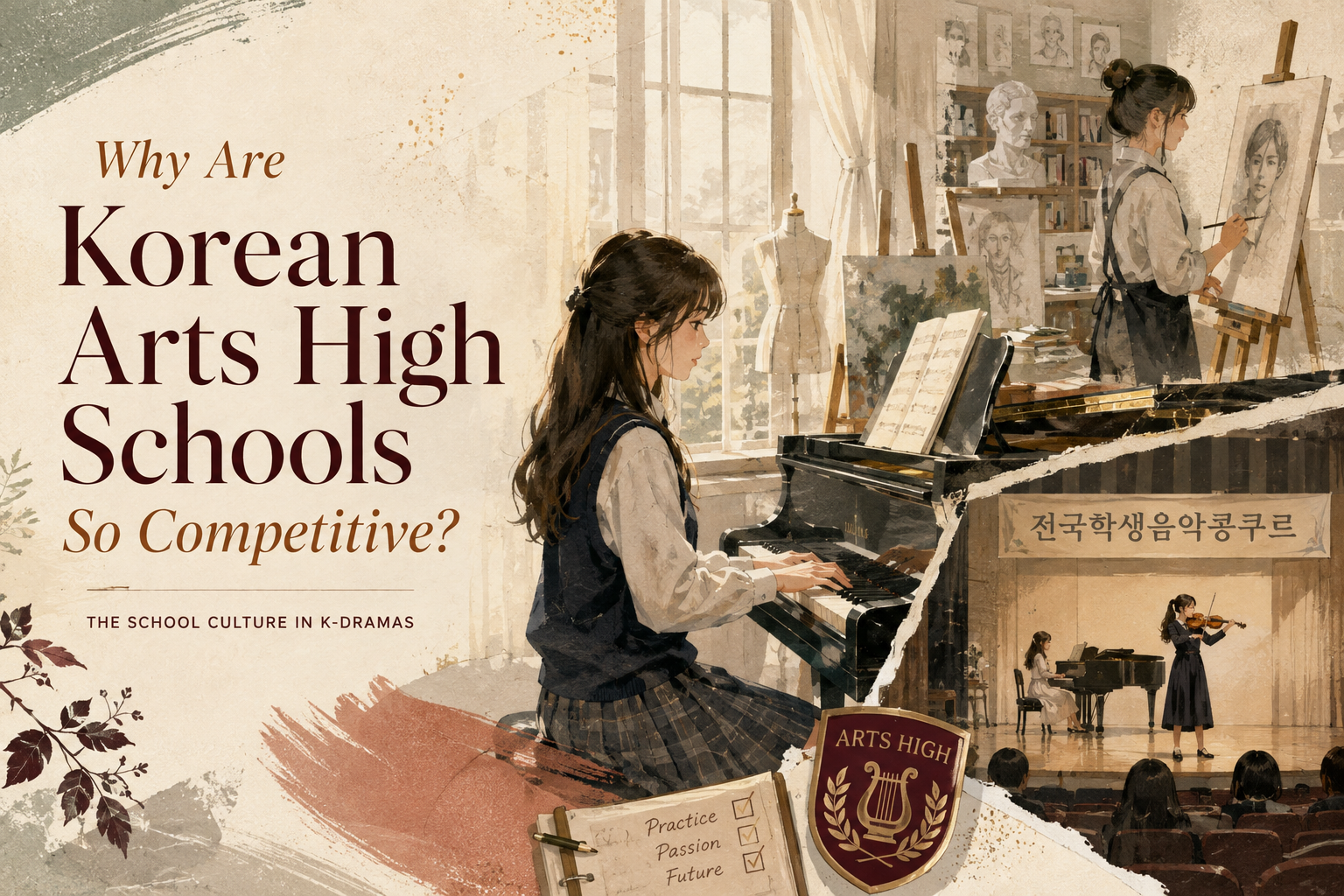
Why do students at Korean arts high schools compete so fiercely, even with their friends? Explore the education system, college admissions, competitions, costs, and natural talent behind the intense culture of Korean arts high schools, as portrayed in K-Dramas.
Why Do Korean Students Choose Korean Arts High Schools at Such a Young Age?
Have you ever watched a K-Drama featuring high school students majoring in music or art, practicing for hours every day in addition to attending regular classes?
Korean arts high schools are specialized schools where students receive professional training in fields such as music, visual arts, and dance alongside general academic education. For students who plan to pursue careers in the arts or attend art-related universities, these schools offer an opportunity to develop their practical skills systematically from an early age.
I once knew a friend who decided to pursue classical singing while in middle school and went on to attend an arts high school. At the time, people around us often commented that his relatively large head and ability to produce a strong head voice were advantageous for classical singing. Of course, head size alone cannot determine someone’s vocal talent. 🙂 However, that experience made me realize for the first time that students pursuing the arts often consider their voices, artistic senses, and even physical characteristics when choosing their career paths at a young age.
The Intense Competition in Korean Arts High Schools: College Admissions and Music Competitions
Getting into Korean arts high schools is not the end of the journey. In many ways, it marks the beginning of a new phase of competition.
Students have to balance regular academic subjects with intensive training in their chosen fields. They also prepare for private lessons, daily practice, performances, and competitions, all while keeping their future university plans in mind.
In South Korea, admission requirements for university programs in the arts vary by institution and admission track. Practical examinations play a significant role in many programs. Some admission tracks also consider awards from specific competitions as part of their eligibility requirements or evaluation criteria. However, winning a competition is not a universal requirement for admission to every arts university.
The financial burden can also be considerable. Instruments, private lessons, practice spaces, and the materials needed to prepare for performances and exhibitions can all involve substantial expenses.
Specialized arts schools and pre-college music programs also exist in the United States and Europe, so intense competition is not unique to South Korea. However, in Korea, specialized arts education often overlaps with the pressure of university admissions. As a result, classmates studying the same subject can become both their closest companions and their strongest competitors.
Korean Arts High Schools: Is Hard Work Enough Without Natural Talent?
When discussing arts education, it is difficult to avoid the question of whether hard work or natural talent matters more.
Personally, I believe that reaching the highest levels in visual arts, music, or sports requires an enormous amount of effort. At the same time, certain natural abilities, such as musical pitch, rhythm, expressiveness, and physical characteristics, can also play a role.
However, success cannot be explained by DNA alone. Individual practice, educational opportunities, teachers, personal experiences, and family support all contribute to a student’s development.
These realities also provide compelling material for K-Dramas set in Korean arts high schools. When a student who has practiced for years meets another student with exceptional natural talent, friendship and admiration can easily turn into insecurity and rivalry.
The intense relationships among students in Four Hands can also be understood in the context of this competitive arts school environment. The drama’s setting brings together students who are passionate about their chosen fields but may have very different levels of experience and talent.

How Competition in Korean Arts High Schools Is Portrayed in K-Dramas
It is easy to misunderstand the rivalry among students in K-Dramas if we simply assume that Korean students are naturally competitive. There is much more to the story.
Students at Korean arts high schools often choose their specialties at a relatively young age. They then balance academic studies with professional-level practical training while preparing for university admissions and future careers. In many cases, their families also invest considerable time and money in supporting their education.
As a result, seeing a friend perform an outstanding piece of music or create an exceptional work of art can mean much more than simply recognizing a friend’s talent. It can also prompt students to question their own abilities and reconsider their future prospects.
Understanding the background of Korean arts education makes it easier to appreciate why music competitions, practical examinations, and rivalries are such prominent themes in K-Dramas.
Ultimately, Korean arts high schools are places where talent and hard work, friendship and competition, all come together at close quarters.