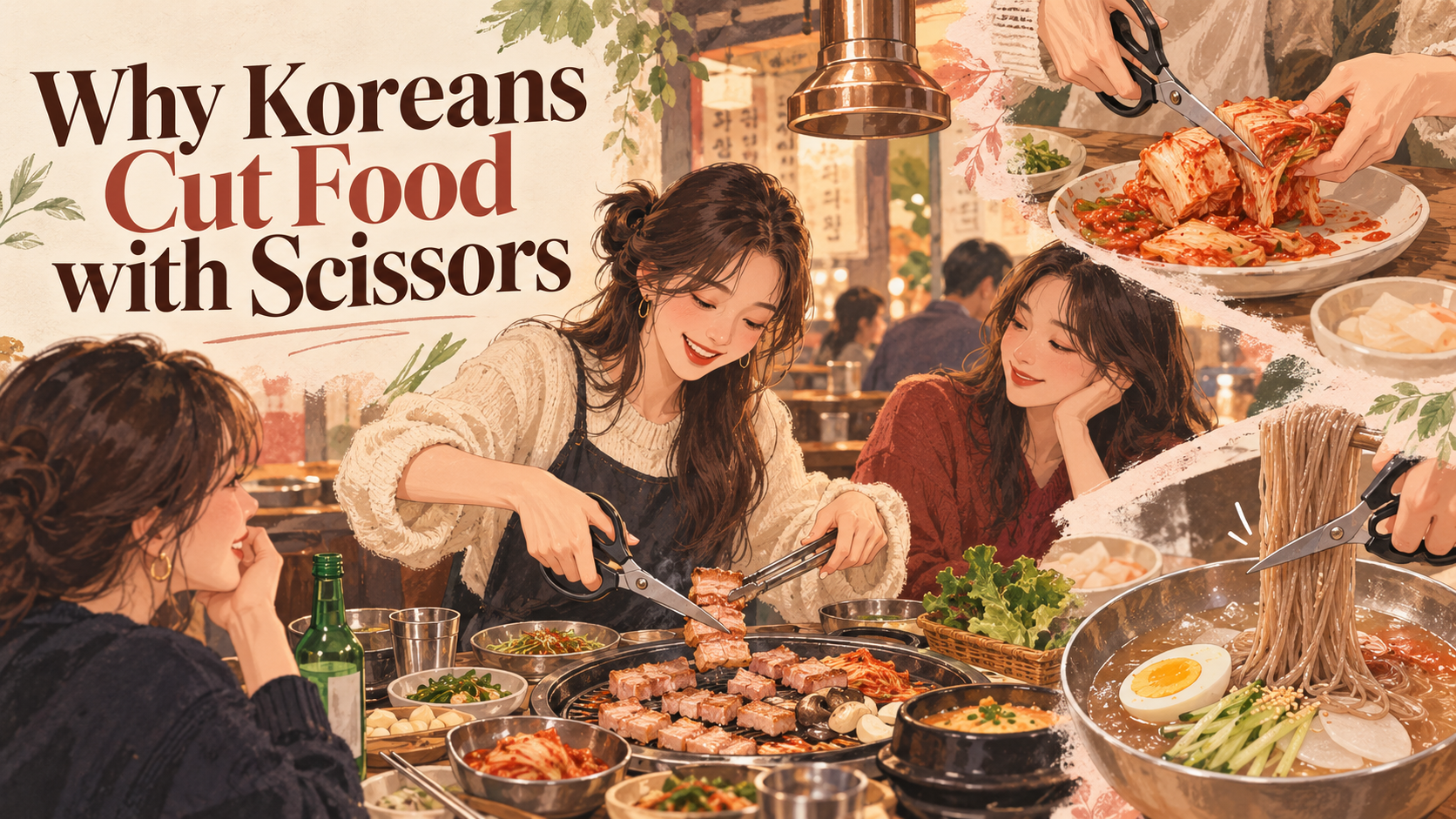
If you have ever wondered why do Koreans use scissors for food, K-Dramas offer plenty of examples. From samgyeopsal and kimchi to naengmyeon, discover why food scissors became such a practical part of Korean dining culture.
Why Do Koreans Use Scissors for Food?
If you watch K-Dramas, you may have noticed a dining habit that looks slightly unusual to international viewers. At a restaurant, someone picks up a pair of scissors to cut meat directly on the grill. At home, kimchi might be snipped into smaller pieces right over a plate. Even a bowl of naengmyeon, or Korean cold noodles, may come with scissors.
So, why do Koreans use scissors for food instead of simply using a knife?
In Korea, food scissors are an extremely practical kitchen tool. Take samgyeopsal, or pork belly, for example. Large strips of meat can be held with tongs and cut directly over the grill without moving them to a cutting board. Long pieces of kimchi, chewy meat, and noodles can also be quickly divided into bite-sized portions right at the table.
I use scissors naturally when cutting kimchi or naengmyeon, and when grilling samgyeopsal or beef. To many Koreans, kitchen scissors do not feel like an unusual utensil at all. They can feel almost as ordinary and useful as tongs, chopsticks, or a spoon.
Why Do Koreans Use Scissors for Food at the Table?
The popularity of Korean food scissors is not just about convenience. They also fit particularly well with the way many Korean meals are prepared and shared.
At Korean barbecue restaurants, for example, cooking continues at the table. Large pieces of meat are grilled in the center while everyone eats together. Instead of carrying the meat back to a kitchen counter, placing it on a cutting board, and using a knife, you can simply hold it with tongs and snip it into smaller pieces over the grill.
Food scissors became increasingly familiar at Korean dining tables during the rapid growth of restaurant culture in the late 20th century. Accounts of their spread vary, but they became particularly useful for foods such as grilled meat and long, chewy noodles. By the 1980s, as eating out and large barbecue-style restaurants became increasingly common, scissors were becoming an increasingly familiar tool at Korean tables.
There is also a Korean expression, ppalli-ppalli (빨리빨리), meaning “quickly, quickly.” It is often used to describe Korea’s strong preference for speed and efficiency in everyday life. Of course, it would be too simple to say that Koreans use food scissors because of ppalli-ppalli culture alone. Still, cutting food quickly where it is already being cooked or served fits naturally with that practical mindset.
Personally, I think of scissors less as a tool for making food look beautiful and more as a tool for making food easier to eat—quickly and efficiently.
In many Western dining settings, diners cut food such as steak individually with a knife on their own plates. Korean meals, by contrast, often involve shared dishes and food that continues cooking at the table. In that setting, scissors simply make sense.
Why Are Korean Food Scissors So Common in K-Dramas?
In K-Dramas, food scissors usually appear in completely ordinary dining scenes.
Friends might sit around a Korean barbecue grill while one person holds a strip of samgyeopsal with tongs and cuts it into bite-sized pieces. At a family meal, someone may cut a long piece of kimchi for another person. At a naengmyeon restaurant, diners may make one or two cuts through a bundle of long noodles before eating.
These scenes are interesting because they are usually not included to explain Korean culture to foreign viewers. They simply reflect real Korean eating habits.
That is exactly why they can stand out to international audiences. Something so ordinary that a Korean character would never stop to explain it may look completely unfamiliar to someone watching from another country.
There can also be a small social meaning in Korean food scissors at a barbecue table.
The person holding the scissors and tongs often becomes the person managing the grill—turning the meat, checking whether it is cooked, cutting it, and sometimes placing finished pieces in front of other people. Today, this role may simply go to whoever enjoys grilling or happens to be closest to the tools, although in the past age and workplace hierarchy could sometimes influence who handled the grill.
That simple action can therefore tell you something about the relationships between characters. Someone carefully cooking and cutting meat for another person may be doing more than preparing dinner—they may also be showing care.

Conclusion
The next time you see someone cutting samgyeopsal, kimchi, or naengmyeon with scissors in a K-Drama, there is no need to wonder whether they have grabbed a pair of office scissors by mistake.
Koreans generally use dedicated kitchen or food scissors, and they are particularly useful for foods that are already on a grill, in a bowl, or on the table. They make it easy to turn large or awkward foods into bite-sized pieces without needing a separate cutting board.
So, why do Koreans use scissors for food? The simplest answer is practicality. But the habit also makes sense within a dining culture where people often cook, divide, and share food together at the table.
What looks like a surprising K-Drama detail to an international viewer is, for many Koreans, simply an ordinary part of eating.
Note from Rebecca: Have a question about K-Dramas or Korean culture? Feel free to leave a comment below!