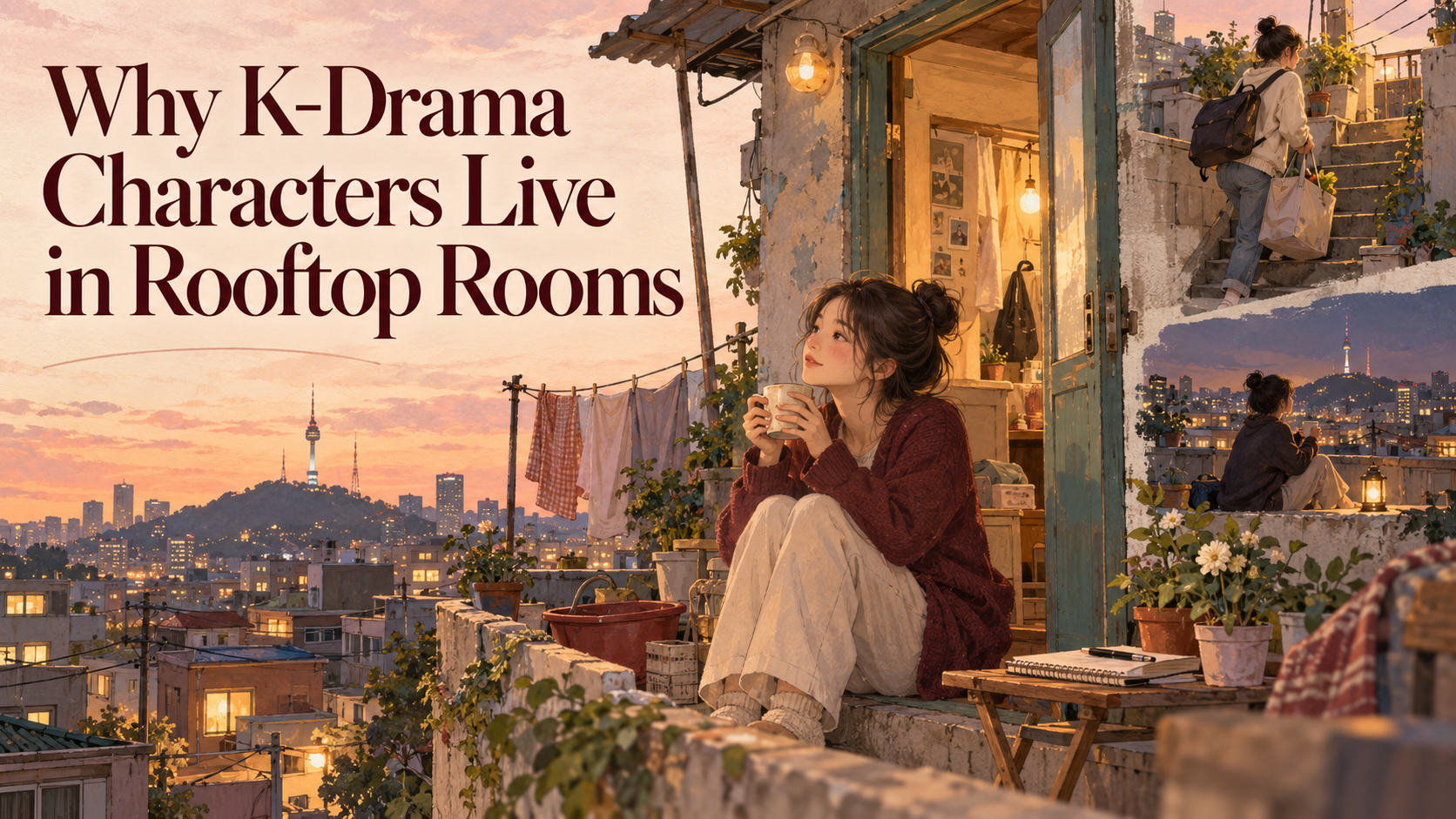
Why do struggling K-Drama characters often live in a Korean rooftop apartment? Discover the reality of Korea’s rooftop homes, from affordable rent and harsh living conditions to youth culture and romantic rooftop scenes in K-Dramas.
What Is a Korean Rooftop Apartment?
If you watch enough K-Dramas, you will eventually see a familiar scene: a character climbs several flights of stairs, opens a door leading to the rooftop, and walks into a tiny home sitting on top of the building.
For international viewers, it naturally raises a question: Do people in Korea really live on rooftops?
Yes, they do—or at least some people have. A Korean rooftop apartment, known in Korean as oktapbang(옥탑방), is a small residential space built on the rooftop of a low-rise apartment building, villa, or detached house.
These homes are usually small and have traditionally been cheaper to rent than conventional studio apartments. Because of this, rooftop rooms have often been associated with young adults, people living alone, and those trying to establish themselves in expensive cities such as Seoul.
This is very different from the image of a penthouse in the United States or Europe. In many Western cities, living at the top of a building can mean luxury, privacy, and an impressive skyline view. In Korea, an oktapbang has historically represented almost the opposite end of the housing market.
Still, rooftop living has a few unique advantages.
Residents may have direct access to the rooftop, where they can dry laundry, place a small table and chairs, grow plants, or enjoy an open view if the surrounding buildings are low enough.
Those features also happen to make the rooftop an ideal setting for K-Drama scenes.
Why Do Poor K-Drama Characters Live in a Korean Rooftop Apartment?
There is a practical reason why the Korean rooftop apartment has become associated with financially struggling characters.
As Korean cities developed rapidly and housing costs in Seoul increased, finding an affordable place to live became an important issue for young adults and single-person households. Small rooms constructed on rooftops could sometimes offer a cheaper alternative to regular studio apartments or larger homes.
But lower rent often comes with significant disadvantages.
When I think of an oktapbang, the first thing that comes to mind is not the beautiful nighttime views shown in K-Dramas. I think about the difficult living conditions.
Because the room sits directly beneath the roof, it can absorb intense sunlight during Korea’s hot and humid summers. In winter, poor insulation can make it particularly cold. The living space is often small, and reaching it may require climbing several steep flights of stairs.
In other words, real rooftop living is not necessarily romantic.
That reality is precisely why the oktapbang works so well as visual storytelling in K-Dramas.
A wealthy character living in a spacious luxury apartment can be contrasted immediately with a protagonist living in a tiny rooftop room. The drama does not need several minutes of dialogue explaining their economic situations. Their homes already tell the audience much of the story.
A rooftop apartment can silently communicate: this character does not have much money, life is difficult, but they are still trying to build a future.
Why Does a Korean Rooftop Apartment Look So Romantic in K-Dramas?
Here is the interesting contradiction: an oktapbang can be uncomfortable in real life, yet it often looks surprisingly beautiful on screen.
Much of that comes from the rooftop itself.
Characters can place a small table outside, eat fried chicken and drink beer with friends, talk beneath hanging laundry, or sit quietly while looking at the lights of Seoul at night.
These scenes would be difficult to recreate inside an ordinary studio apartment.
A rooftop is also a fascinating space because it is neither completely indoors nor completely outdoors. It feels private while remaining open to the city around it.
That makes it especially suitable for a familiar type of K-Drama character: a young adult who does not have much money but finally has a place of their own, someone trying to rebuild life after failure, or a protagonist experiencing independence for the first time.
In many Western TV shows, a tiny studio apartment can symbolize the difficult but exciting beginning of independent adulthood. In Korean dramas, the rooftop room has often served a similar narrative purpose.
This is why rooftop dinners and nighttime conversations can feel romantic without necessarily denying the difficult reality of the housing itself.
Instead, they create a very K-Drama-like idea: you may not have much, but this small space is yours, and a new life can begin here.
There is also a classic romantic-drama fantasy connected to this setting. The kind-hearted heroine struggling through life in a humble rooftop room may eventually cross paths with a wealthy male lead—the modern K-Drama version of the old “Prince Charming” story.
The contrast between her tiny rooftop home and his luxurious world makes the difference between their lives instantly visible, while giving the audience a physical space in which her independence, hardship, friendships, and hopes can unfold.

The Korean Rooftop Apartment Is More Than a K-Drama Setting
The next time you see a K-Drama character climbing the stairs to a tiny home on a rooftop, do not think of it only as an attractive filming location.
The oktapbang reflects a real aspect of Korean urban life, including high housing costs, affordable housing needs, and the experiences of young people trying to establish independent lives.
A real Korean rooftop apartment is not always as romantic as television makes it look. It can be painfully hot during summer, cold during winter, difficult to access, and extremely small.
Yet that contrast is exactly what makes the setting so powerful in K-Dramas.
A character may live in a tiny room and have very little money. But just outside the door is an open rooftop where friends can share a meal, two people can fall in love, or someone can look across the lights of Seoul and imagine a different future.
That is why the oktapbang has become such a recognizable K-Drama setting: it is a place where financial struggle, independence, new beginnings, friendship, romance, and the dreams of youth can all exist at the same time.
Note from Rebecca: Have a question about K-Dramas or Korean culture? Feel free to leave a comment below!