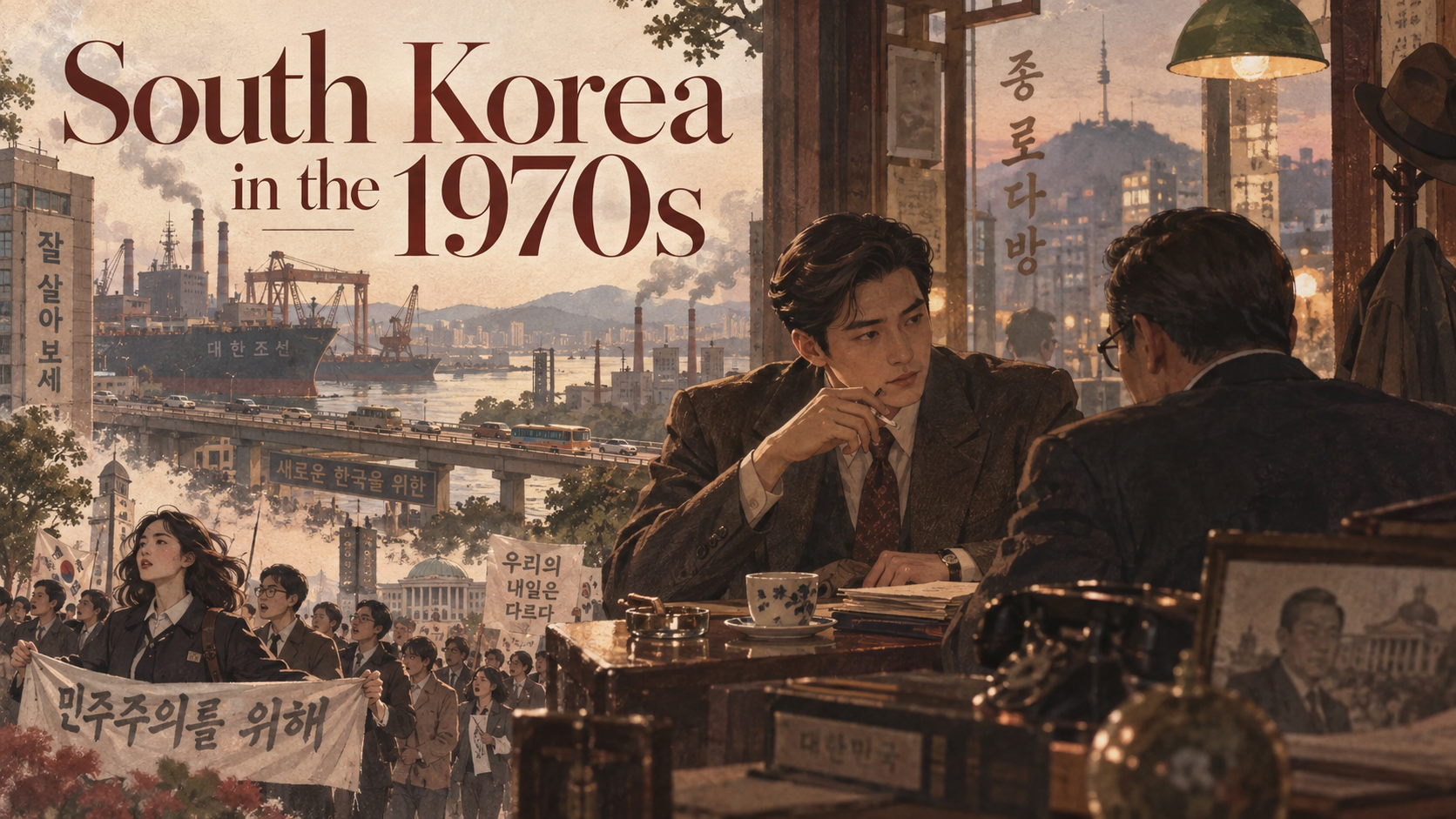
Why do 1970s K-Dramas feel so tense and politically charged? South Korea in the 1970swas shaped by rapid growth, authoritarian rule, the KCIA, and dramatic social change.
South Korea in the 1970s: Why Does It Feel So Different in K-Dramas?
Watch a K-Drama set in 1970s Korea and you may quickly notice something unusual. Intelligence agents know businessmen. Prosecutors clash with powerful officials. Military figures appear close to politics, and government institutions seem to reach into almost every part of society.
Why were these worlds so closely connected?
The answer lies in the real history of South Korea in the 1970s.
The decade was dominated by President Park Chung-hee, who had taken power through a military coup in 1961 and later became president. In 1972, Park introduced the Yushin Constitution, which removed presidential term limits and strengthened an already highly centralized political system. Opposition to the Yushin system grew among students, intellectuals, religious figures, workers, and opposition politicians.
At the same time, Korea was changing at breathtaking speed.
The government pushed export-led industrialization, expanded infrastructure, promoted the Saemaul Undong rural development campaign, and invested heavily in industries such as steel, shipbuilding, machinery, petrochemicals, and electronics. The Heavy and Chemical Industry drive launched in the 1970s became an important part of Korea’s industrial transformation.
This is what makes the decade so fascinating. South Korea in the 1970s was not simply a story of economic success or political repression. Both were happening at the same time.
South Korea in the 1970s: The KCIA, Presidents, and the Road to Democracy
To understand political thrillers set in this period, it helps to know that South Korea’s democratic system did not develop in a straight line.
The Republic of Korea was established in 1948. President Syngman Rhee left office after the April 19 Revolution in 1960. Park Chung-hee then seized power in the May 16 military coup of 1961 and remained the central political figure until his assassination in 1979.
After Park’s death, democracy did not arrive immediately. Chun Doo-hwan and other military figures expanded their power following the December 12, 1979 military coup, and authoritarian government continued into the 1980s. The nationwide June Democratic Uprising of 1987 eventually helped bring about constitutional reform and direct presidential elections.
Then there was the KCIA—the Korean Central Intelligence Agency.
Created in 1961, the KCIA became one of the most powerful institutions associated with the Park era. It was renamed the Agency for National Security Planning in 1981 and reorganized as today’s National Intelligence Service in 1999.
International viewers sometimes compare it with the CIA, but that comparison only goes so far. Both were intelligence agencies, yet the KCIA developed within Korea’s own Cold War, anti-communist, and authoritarian political environment and played a significant domestic role.
That history explains why a fictional intelligence officer in a 1970s K-Drama can seem connected not only to national security, but also to politics, business, and struggles over power.
Why South Korea in the 1970s Matters in Made in Korea
This is where Made in Korea becomes especially interesting.
Disney+ describes the series as a story set in 1970s South Korea about a man who lives a double life as a KCIA agent and businessman while being pursued by a determined prosecutor.
To a modern viewer, that combination may sound deliberately exaggerated: an intelligence agent, businessman, prosecutor, political connections, and criminal intrigue all in the same story.
But the historical setting makes the combination much easier to understand.
During South Korea in the 1970s, the state took an unusually active role in directing economic development. Large companies benefited from government-led industrial policies, while intelligence and security institutions possessed significant political power. The growth of heavy industry was closely tied to state policy, financing, and support for selected industries and firms.
For Western viewers, the mood may sometimes resemble political dramas about Cold War Washington or the Watergate era—secret meetings, powerful institutions, businessmen close to government, and officials operating in moral gray zones.
But Korea’s story was different.
This was a country undergoing extraordinarily rapid industrialization while still living under authoritarian political rule. That contradiction—modern factories and ambitious economic growth alongside restricted political freedoms—is one of the keys to understanding K-Dramas set in this era.
And Made in Korea should still be viewed as drama, not documentary. Its characters and plot are fictionalized, even though the KCIA and the historical atmosphere surrounding it are real. Knowing the history allows viewers to recognize what the drama is borrowing from reality without assuming that every event actually happened.

Final Thoughts
If modern Seoul is your main image of Korea—skyscrapers, global companies, K-Pop, technology, and a vibrant democracy—South Korea in the 1970s can feel like another country entirely.
Yet many forces that shaped modern Korea were already taking form during this decade: rapid industrialization, the rise of major corporations, powerful state institutions, political opposition, and demands for democracy.
Park Chung-hee was assassinated in October 1979 by KCIA director Kim Jae-gyu. Political upheaval continued afterward, and it was not until the democratic movement of 1987 that direct presidential elections became part of the new constitutional order.
That is why 1970s Korea is such a powerful setting for K-Dramas.
When you see an intelligence officer meeting a businessman in a shadowy room, a prosecutor challenging someone far more powerful, or political decisions becoming tangled with money and ambition, those scenes are not appearing in a historical vacuum.
Behind them is one of the most dramatic periods in modern Korean history—a time when economic transformation, authoritarian power, and the struggle for democracy were all unfolding at once.
Note from Rebecca:
Have a question about K-Dramas or Korean culture? Feel free to leave a comment below!