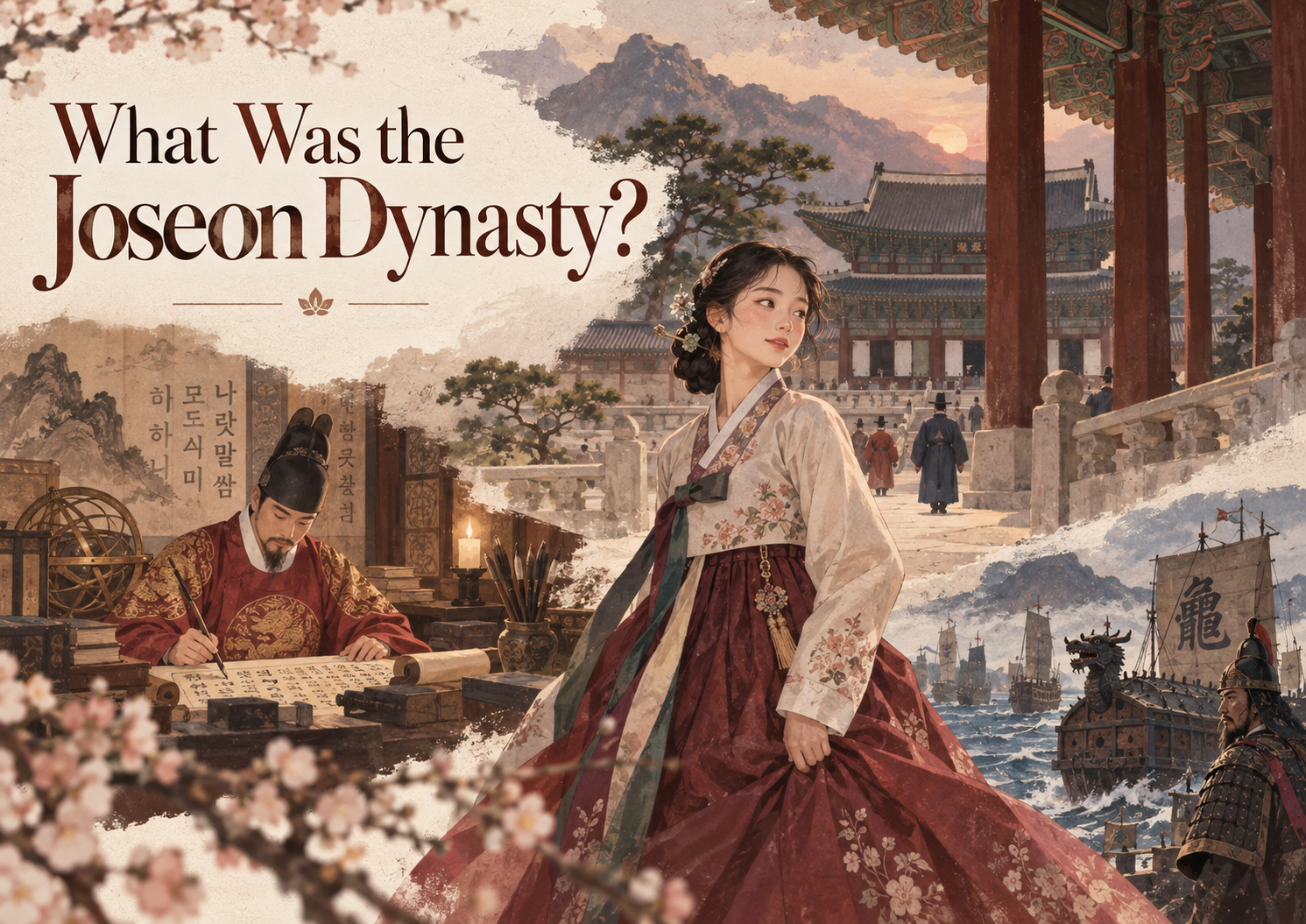
Why does the Joseon Dynasty in K-Dramas appear so often? Discover 500 years of Joseon history, from Ming and Qing China to Japan, King Sejong, the Imjin War, and Kings Yeongjo and Jeongjo.
What Was the Joseon Dynasty in K-Dramas?
International viewers watching Korean historical dramas may wonder, “Why do so many K-Dramas take place during the Joseon period?”
The Joseon Dynasty was Korea’s last dynastic kingdom, founded in 1392 and lasting for more than 500 years. Korea has a history spanning roughly 5,000 years, developing through ancient Gojoseon, the Three Kingdoms of Goguryeo, Baekje, and Silla, the Goryeo Dynasty, and finally the Joseon Dynasty before the emergence of modern Korea.
Among these periods, Joseon left an especially deep influence on modern Korean culture. Royal palaces, the king and royal family, the yangban elite, the social class system, civil service examinations, and Confucian family values that often appear in historical K-Dramas all have roots in Joseon society.
Joseon also existed within a constantly changing East Asian political environment. In its early centuries, it maintained diplomatic relations with China’s Ming Dynasty while facing Jurchen groups along its northern borders. Later, as the Ming weakened and the Qing Dynasty rose to power, the regional order changed dramatically.
Across the sea, Joseon also maintained both trade and conflict with Japan. Raids by Japanese pirates, known as wokou or waegu in Korean historical records, and the massive Japanese invasions that began in 1592 had a lasting impact on Joseon history.
Understanding this wider regional context makes the Joseon Dynasty in K-Dramas much easier to follow.
Joseon Dynasty in K-Dramas: From King Sejong to the Imjin War
Many of the most dramatic events from Joseon history repeatedly appear in Korean films and television dramas.
The founding of Joseon, the Strife of Princes, King Taejong’s efforts to strengthen royal authority, and King Sejong’s creation of Hunminjeongeum, now known as Hangul, is a popular historical subject. Hangul is often described as the world’s only writing system whose creator, date of creation, and scientific design principles are all clearly documented. The reign of Yeonsangun, often remembered as one of Joseon’s most controversial rulers, and the Jungjong Coup are also frequently used as material for palace intrigue.
One of the most important turning points came in 1592, when the forces of Japanese ruler Toyotomi Hideyoshi invaded Joseon. This conflict is commonly known in Korea as the Imjin War.
Admiral Yi Sun-sin’s naval victories remain some of the best-known episodes in Korean history. Volunteer civilian militias, known as uibyeong, also fought against the invasion, and their stories continue to appear in historical dramas and films.
After the war, another major regional transformation took place. The Ming Dynasty declined while the Manchu-led Later Jin, which later became the Qing Dynasty, became increasingly powerful.
King Gwanghae attempted a pragmatic diplomatic policy between the Ming and Later Jin, but he was eventually removed from the throne. During the reign of King Injo, Joseon was invaded by the Qing in the conflict known as the Manchu invasion of 1636, or Byeongja Horan in Korean.
K-Dramas such as My Dearest use this turbulent period as a backdrop, showing how ordinary people’s lives were affected by war and international politics.
Kings Yeongjo and Jeongjo: Is the Joseon Dynasty in K-Dramas Historically Accurate?
The later Joseon period is another favorite setting for K-Dramas.
Political struggles during King Sukjong’s reign, the tragic relationship between King Yeongjo and his son Crown Prince Sado, and King Jeongjo’s reform efforts have been portrayed again and again in Korean films and television series.
Some dramas combine real historical figures with fictional romance and imagined personal stories. The Red Sleeve, for example, centers on King Jeongjo but blends documented history with dramatized relationships and emotional storytelling.
Jeongjo strengthened the royal library and research institution known as Gyujanggak, promoted talented officials, and attempted several reforms. After his death, however, political power increasingly became concentrated in a small number of powerful families, a period often associated with sedo politics.
By the nineteenth century, Joseon faced not only domestic social and political problems but also growing pressure from Qing China, Japan, and Western powers. Reform movements did emerge, but Korea was also caught in a rapidly changing international order.
It is tempting to wonder whether Joseon might have modernized more successfully if stronger reform-minded rulers had continued after Jeongjo. This can be an interesting historical question, but it remains a counterfactual rather than a historical fact.
This is also why viewers should remember that the Joseon Dynasty in K-Dramas is never a perfect copy of history. Historical dramas often mix real events, documented figures, romance, and fictional characters to create a more compelling story.

Final Thoughts
The Joseon Dynasty was much more than an era of kings, hanbok, and beautiful palaces.
For more than five centuries, Joseon survived enormous changes in East Asia: the transition from Ming to Qing power in China, Japanese invasions, internal political conflict, and eventually growing pressure from Japan and Western powers.
Knowing about King Sejong and Hangul, Admiral Yi Sun-sin and the Imjin War, King Gwanghae and the changing relationship between Ming and Qing, Crown Prince Sado, and the reforms of Kings Yeongjo and Jeongjo can completely change the way you watch Korean historical dramas.
Once you understand the history behind the Joseon Dynasty in K-Dramas, a sageuk becomes much more than a palace romance. The characters’ choices, loyalties, social positions, and political conflicts begin to make much more sense.
Note from Rebecca:
Have a question about K-Dramas or Korean culture? Feel free to leave a comment below!