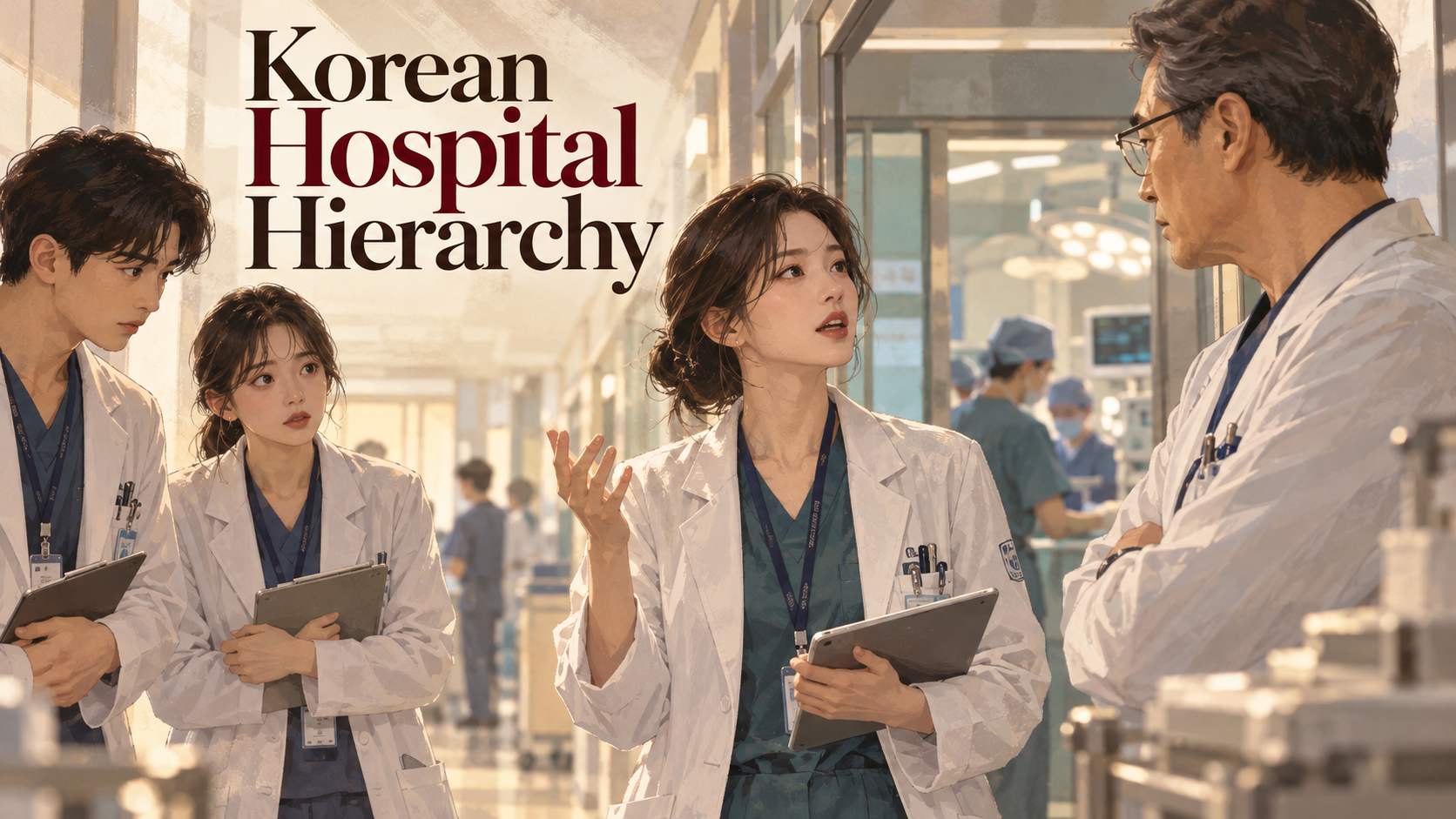
Why is the Korean Hospital Hierarchy so strict? Explore senior doctors’ authority, medical training, workplace culture, and the reality behind Doctor X.
How Does the Korean Hospital Hierarchy Work?
If you watch Korean medical dramas, you’ve probably noticed how quickly young doctors respond when a senior physician gives an order. Sometimes, even when they disagree, they hesitate to speak up.
Why do senior doctors seem to have so much authority in Korean hospitals?
To understand the Korean Hospital Hierarchy, we need to look beyond the dramatic confrontations we see on television.
In South Korea’s university hospitals, doctors with different levels of experience and responsibility work together. Medical professors, board-certified specialists, interns, and residents all play different roles in patient care.
An intern is a newly licensed doctor receiving supervised clinical training, while a resident undergoes specialized training in a particular medical field. However, not every medical specialty follows exactly the same training pathway.
Like hospitals elsewhere, Korean hospitals depend on experienced physicians to guide junior doctors and oversee complex medical decisions.
But there is another cultural element.
In Korea, relationships between seniors and juniors often extend beyond formal job titles. The Korean terms sunbae (senior) and hubae (junior) describe relationships based on who entered a school, university, or workplace earlier.
These relationships often involve expectations of respect, appropriate language, and consideration for senior colleagues.
In a hospital, professional authority can therefore overlap with age and seniority.
However, medical hierarchy is not simply about respecting older people or following traditional etiquette.
During emergencies, knowing who makes decisions, gives instructions, and performs specific tasks can directly affect a patient’s life.
A clear chain of command can help medical teams respond quickly when every second matters.
The real question is: When does a necessary system of medical leadership become excessive obedience to authority?
Why Do Senior Doctors Have So Much Authority in Korea?
A friend of mine who attends medical school once told me something that helped me understand this culture.
In an operating room, every second can matter. A surgeon’s instructions and the medical team’s responses must be carefully coordinated because even a small delay or misunderstanding can put a patient at risk.
That explanation makes sense when you consider how many professionals are involved in a single operation.
Surgeons, anesthesiologists, nurses, and other healthcare workers must cooperate while performing different responsibilities.
Experienced physicians often lead important clinical decisions, while other team members carry out their assigned tasks and communicate essential information.
In these situations, clear leadership and efficient teamwork are crucial for patient safety.
But there is an important distinction between respecting medical expertise and obeying authority without question.
If a senior doctor makes a potentially dangerous decision, junior doctors and other healthcare professionals need to feel comfortable raising concerns.
A successful medical team requires both coordinated leadership and open communication.
The structure of medical careers also helps explain why senior physicians can have considerable influence.
According to my friend, when medical graduates move from internship training into residency in their preferred specialty, their relationships with senior doctors and the evaluations they receive can matter alongside their medical knowledge and abilities.
Residency selection in Korea may involve examination results, internship performance evaluations, and interviews. The specific requirements vary by hospital and specialty.
Personal connections are not an official selection criterion, but evaluations and professional relationships can still feel important to young doctors trying to establish their careers.
Imagine spending years working toward becoming a doctor, only to face another highly competitive stage when choosing your specialty.
Even among people with impressive academic achievements, competition for desirable training positions and career opportunities can be intense.
In that environment, junior doctors may become especially conscious of how their supervisors perceive them.
This helps explain why the Korean Hospital Hierarchy can feel more complicated than a simple difference in medical experience.
Professional training, career evaluations, and traditional expectations surrounding seniority can all influence workplace relationships.
How Is Korean Hospital Culture Different from Other Countries?
One of the most satisfying moments in a Korean medical drama is when a young doctor finally challenges a powerful senior physician.
These scenes are compelling because they bring two competing pressures into conflict: making the right medical decision and respecting someone with greater authority.
For viewers who understand Korea’s emphasis on seniority and the pressure to constantly read the room and be mindful of their superiors, watching someone speak so directly can be especially cathartic.
I think that is part of what makes Gye Soo-jung, the central character of Doctor X: Mafia in White, so appealing.
In the first episode, Gye Soo-jung notices that the hospital director appears to be experiencing a medical problem while performing surgery.
She suggests stopping the operation and arranging further examinations. However, the other medical professionals dismiss her concerns.
The situation highlights how difficult it can be to challenge a senior figure, even when there may be an important medical reason to do so.
Instead of quietly accepting the authority of others, Gye Soo-jung openly questions their decisions.
Her willingness to say what others hesitate to express creates a sense of satisfaction for viewers, especially in situations where everyone else seems reluctant to disagree.
Of course, hospital hierarchies are not unique to South Korea.
In the United States and European countries, experienced physicians also supervise residents, evaluate their progress, and take responsibility for important medical decisions.
Operating rooms around the world depend on clearly defined responsibilities and effective teamwork.
One cultural distinction is that, in Korea, professional rank can overlap with age and school seniority. A senior physician may be respected not only because of their medical experience but also because of their position within a broader network of senior-junior relationships.
However, attitudes toward authority vary between countries, hospitals, medical specialties, and individual physicians.
It would be misleading to suggest that every Korean hospital is authoritarian or that Western hospitals operate without rigid hierarchies.
Research on healthcare communication has also identified the risks of excessive hierarchy. When junior medical professionals fear negative reactions from supervisors, they may hesitate to report potential problems.
This matters because raising concerns, asking questions, and sharing information can prevent medical errors.
For that reason, patient safety efforts increasingly emphasize creating environments where healthcare workers can speak up regardless of rank.
The goal is not to eliminate medical leadership. It is to make sure that authority supports good decisions rather than preventing people from questioning them.
Ultimately, the most important issue is not whether a hospital has a hierarchy, but how that hierarchy functions.
The best medical teamwork combines respect for experience with the freedom to raise concerns when a patient’s safety is at stake.
Closing: What Doctor X Reveals About Korean Medical Culture
The Korean Hospital Hierarchy has developed through a combination of demanding medical training, clearly defined professional responsibilities, senior-junior relationships, and career evaluation systems.
This structure can support efficient cooperation in high-pressure medical environments. However, when it becomes too rigid, younger doctors may struggle to express important opinions.
That is one reason Doctor X is so interesting.
The drama reminds us that medical expertise and institutional authority do not always belong to the same person.
A brilliant surgeon may have the skills to save a life while still facing resistance from people with greater power.
The next time you watch a K-Drama scene where a junior doctor hesitates before disagreeing with a senior physician, think about the professional and cultural pressures behind that moment.
What looks like a simple argument in a hospital corridor may reveal a much deeper story about Korean medical culture.