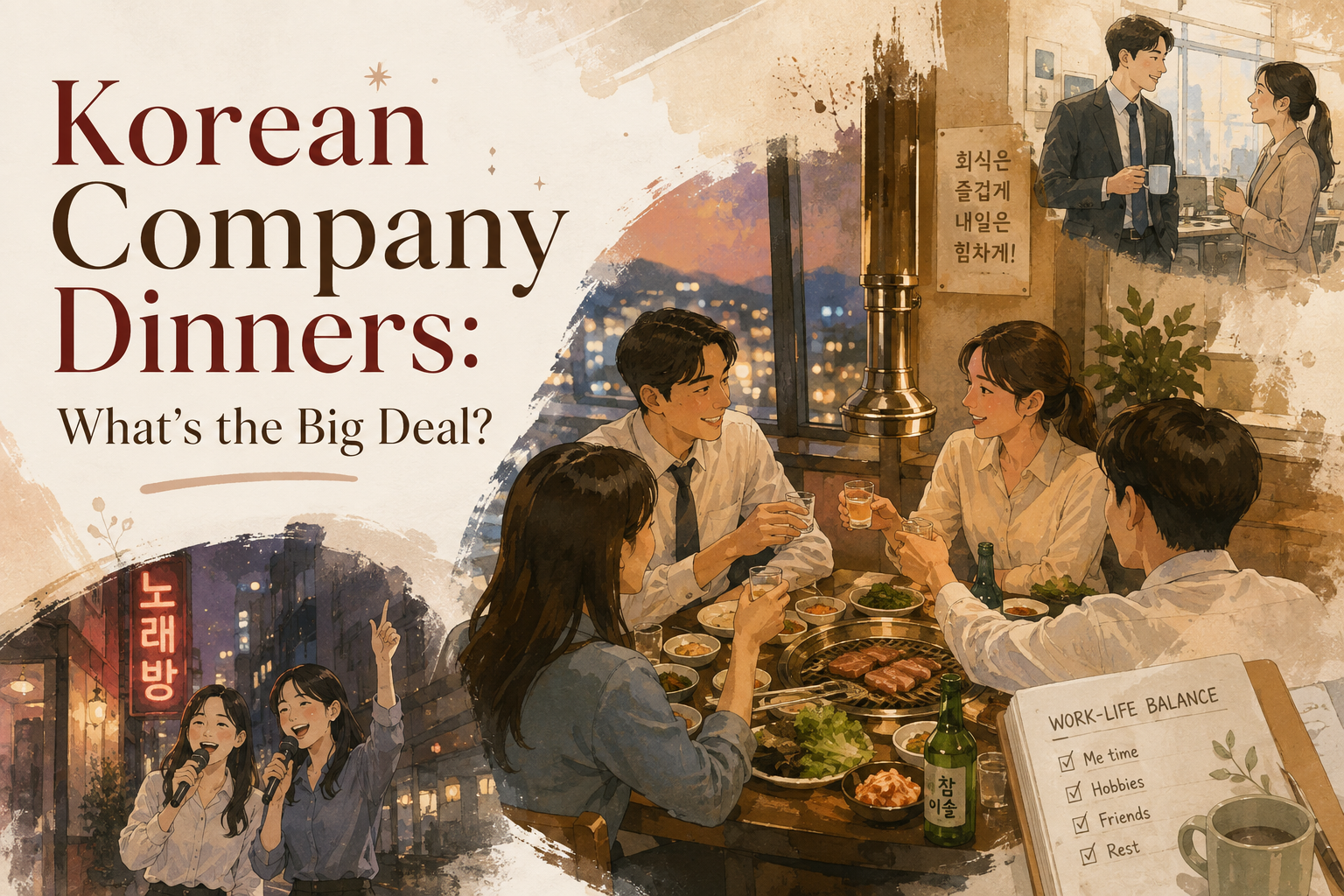
Why do K-Drama office workers spend so much time at company dinners? Discover the history of Korean company dinners, how they compare with after-work gatherings in the US and Europe, and how younger generations and COVID-19 have changed this workplace tradition.
Why Are Korean Company Dinners Such a Big Deal in K-Dramas?
If you watch K-Dramas, you’ve probably noticed how often office workers head to restaurants or bars with their colleagues after work. A typical scene might show a boss suggesting dinner, followed by employees gathering around a table filled with Korean barbecue, soju, and side dishes. Sometimes, the evening continues late into the night, with the group moving on to another bar or even a karaoke room.
For international viewers, this tradition may seem unusual. In countries where people place a strong emphasis on personal time and work-life balance, spending evenings with coworkers may feel like an extension of the working day. So why do Korean employees often socialize with colleagues even after their official working hours?
In Korea, company dinners, known as hoesik (회식), have traditionally been more than just a meal. They have served as opportunities to build relationships, strengthen teamwork, and discuss things that might not come up during regular office hours. However, not every Korean employee enjoys these gatherings. Attitudes toward company dinners vary depending on the workplace, generation, and individual preferences.
In K-Dramas, company dinners often play an important role in workplace conflicts, romantic relationships, and interactions between bosses and employees. Understanding this tradition can reveal a lot about Korean office culture and how it has evolved over time.
How Did Korean Company Dinners Become Part of Work Culture?
The history of Korean company dinners is closely connected to the country’s rapid industrialization and economic growth. During the decades when South Korea was developing into a major industrial economy, many companies emphasized teamwork, loyalty, and a strong sense of belonging. Traditional workplace hierarchies were also deeply rooted in many organizations.
In this environment, company dinners became an important way for colleagues to build personal relationships. During office hours, communication between managers and junior employees was often formal. However, dinner provided an opportunity to interact in a more relaxed setting. Sharing food and drinks sometimes made it easier to discuss personal concerns, workplace challenges, and future plans.
In the early 2000s, it was not unusual for some Korean employees to attend company dinners several times a week, with gatherings continuing late into the night. In certain workplaces, employees who actively participated in these events and maintained good relationships with their managers were perceived as having an advantage in their careers.
There was even a common belief that important professional relationships were built after working hours. While employees completed their official duties during the day, evening gatherings provided additional opportunities to connect with colleagues and managers.
Although this was never true of every Korean company, such expectations helped establish company dinners as a familiar part of traditional office life.
Korean Company Dinners vs. Western After-Work Socializing
Company dinners in Korea and after-work gatherings in Western countries share a common purpose: helping coworkers socialize and build stronger relationships. However, their traditions and expectations can be quite different.
In the United States, happy hours are a familiar way for coworkers to meet after work. Employees may visit a bar, enjoy drinks, or have dinner together. These gatherings are often voluntary, and employees can usually choose whether to attend based on their personal schedules. Some companies also organize formal team dinners, although participation expectations vary considerably.
European workplace traditions differ from country to country. In France and Italy, sharing meals is an important part of social life, and coworkers may occasionally enjoy lunch or dinner together. In the United Kingdom, going to a pub with colleagues after work is also a familiar social activity. However, these gatherings do not necessarily involve the same expectations of participation or hierarchy traditionally associated with Korean company dinners.
In traditional Korean workplaces, company dinners were often organized by managers, with entire teams expected to attend. It was also common for gatherings to continue after dinner, sometimes moving to bars or karaoke rooms.
One interesting Korean expression captures this old attitude: “History is made at night.” While usually used humorously in the context of office life, it reflects the belief that important professional relationships could be built outside regular working hours.
Today, Korean workplaces are also moving toward more flexible and voluntary gatherings. The difference between Korean and Western workplace socializing is therefore not simply about drinking alcohol. It is also about expectations, workplace hierarchy, and how much importance people place on socializing with colleagues after work.
How COVID-19 and Younger Generations Changed Korean Company Dinners
Korean company dinner culture has changed considerably since the early 2000s. In the past, it was relatively common for employees to move from a restaurant to a bar or karaoke room after dinner. Today, however, many employees prefer shorter gatherings and place greater importance on their personal time.
The COVID-19 pandemic accelerated this transformation. Social distancing restrictions made large gatherings difficult, and many companies reduced or temporarily stopped their regular dinners. Even after restrictions were lifted, some workplaces continued to favor smaller and less frequent gatherings.
Younger employees, particularly those often referred to as the MZ generation in Korea, have also contributed to changing workplace expectations. Many place greater importance on work-life balance and prefer to keep their evenings free for hobbies, family, friends, or personal activities. As a result, mandatory drinking sessions and lengthy company dinners have become less appealing in some workplaces.
Interestingly, not all younger employees dislike company dinners. Some newcomers actually enjoy them, especially when the company pays for a delicious meal that they might not otherwise buy for themselves. For these employees, a company dinner can be a convenient way to enjoy good food and get to know their colleagues.
This shows why attitudes toward company dinners cannot be explained by age alone. Whether employees enjoy them often depends on the atmosphere, the food, the length of the gathering, and, most importantly, whether attendance is genuinely voluntary.
What K-Dramas Reveal About Korean Company Dinner Culture
In K-Dramas, company dinners are more than just background scenes. They often reveal the personalities, relationships, and emotions of the characters.
A strict manager might show a surprisingly friendly side after a few drinks, while coworkers who rarely speak openly at the office may finally share their personal feelings over dinner. In other scenes, an awkward drinking incident can lead to misunderstandings or conflicts the following morning.
These scenes combine elements of real Korean workplace culture with dramatic storytelling. For example, scenes in which a boss insists that employees drink or a junior employee feels uncomfortable refusing a drink reflect the hierarchical atmosphere associated with some traditional company dinners.
More recent workplace dramas also portray changing attitudes. Some characters choose to leave early, decline invitations, or enjoy a simple meal without continuing to a bar. These situations reflect the growing importance of personal boundaries and work-life balance in contemporary Korean workplaces.
Korean company dinners are still evolving. Long drinking sessions have become less common in some workplaces, while casual dinners focused on food and conversation remain popular.
For international K-Drama fans, these scenes offer more than entertaining workplace stories. They provide a glimpse into how Korean office culture has changed across generations, how professional relationships are formed, and how employees are redefining the balance between work and personal life.