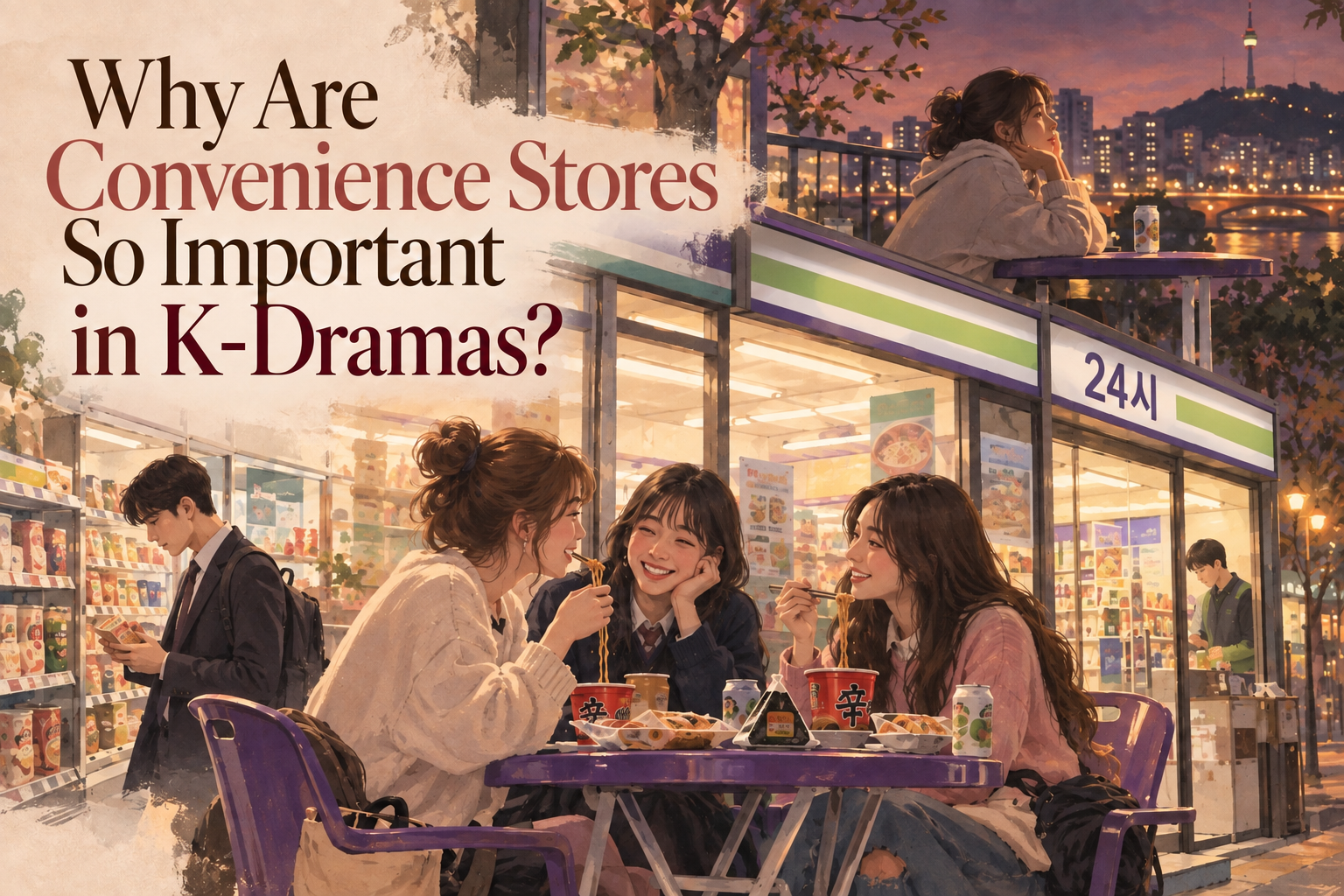
Why do K-Drama characters head to convenience stores late at night? Korean convenience store culture reveals solo meals, friendship, comfort, and the fast-changing rhythm of modern urban life in Korea.
Why Are There So Many Convenience Store Scenes in K-Dramas?
If you watch enough K-Dramas, you may notice how often convenience stores appear. Students stop by after school for cup ramyeon, office workers pick up beer on their way home, and heartbroken characters sit alone at a small table outside a convenience store late at night.
To international viewers, it may look like nothing more than a small neighborhood shop. In Korea, however, convenience stores are deeply woven into everyday life. They sell everything from cup ramyeon, gimbap, and ready-to-eat meals to drinks, household essentials, umbrellas, phone chargers, alcohol, hangover drinks, and some basic over-the-counter medicines.
One of the most important features of Korean convenience store culture is that many stores remain open late into the night, with numerous locations operating 24 hours a day. Even when most of the neighborhood has gone dark, the convenience store may still be brightly lit.
For me, that familiar light late at night makes a convenience store feel like more than just a place to buy something. For some people, it is where they sit alone with a cup of ramyeon and quietly end the day. For students, it can become a tiny hangout where they share snacks, talk, and build friendships.
That is why convenience stores feel so natural in K-Dramas: they are already part of the everyday rhythm of Korean life.
Korean Convenience Store Culture Began with 7-Eleven in 1989
The modern era of Korean convenience stores began in 1989, when the first 7-Eleven opened in Seoul. At the time, the appeal was not that convenience stores sold especially rare products or offered dramatically lower prices than neighborhood grocery stores.
Their biggest difference was simple: they were open 24 hours.
For Korean consumers, being able to buy food and everyday necessities after traditional neighborhood stores had closed introduced a new kind of urban convenience. As both Korean and international brands entered the market, convenience stores rapidly expanded across the country.
Today, more than 50,000 convenience stores operate throughout South Korea, making them an important part of the country’s urban infrastructure.
Korean convenience store culture is also somewhat different from supermarket-centered shopping or the gas-station convenience stores familiar to many people in the United States and parts of Europe. In Korea, convenience stores are densely located near apartment complexes, schools, offices, subway stations, and residential streets.
Their growth reflects Korea’s rapid urbanization and the daily rhythm of a society where students, office workers, commuters, and late-night customers remain active long after traditional shops have closed.
The result is a type of neighborhood space that sits somewhere between a store, a quick restaurant, and an informal meeting place.
Korean Convenience Store Culture in K-Dramas: From Cup Ramyeon to Comfort
Convenience stores do not appear in K-Dramas simply because they are easy filming locations. They are also ideal places to show ordinary relationships in a natural and believable way.
Friends share cup ramyeon and triangle gimbap. An exhausted office worker grabs a simple dinner after working late. Two characters sit outside with canned beer and finally talk about feelings they could not express somewhere more formal.
Unlike an expensive restaurant or stylish café, a convenience store is accessible to almost everyone. That makes it a perfect setting for showing characters in their most ordinary moments.
For me, one of the most distinctive emotions associated with Korean convenience store culture comes from the combination of bright lights, late-night silence, and the presence of a store clerk even when most of the city around you seems to be asleep.
After restaurants, cafés, and shops begin closing for the night, the convenience store is often still there.
This is why K-Dramas sometimes portray it almost like a small refuge in the city—a place where a lonely character can stop for a few minutes without needing a reservation, a companion, or even a particular reason to be there.
At the same time, convenience stores capture many aspects of contemporary Korean life: student friendships, part-time jobs, solo dining, late-night study sessions, quick meals after work, and quiet conversations between people who are still figuring out their relationships.
In just one small space, K-Dramas can show an unexpectedly large part of modern Korea.
Final Thoughts
The history of Korean convenience stores is only a few decades old, but these small shops reflect how rapidly Korean society has changed.
What began with the simple convenience of 24-hour shopping has developed into a space for eating, shopping, spending time alone, meeting friends, and taking a short break from the city.
That is why Korean convenience store culture appears so naturally in K-Dramas.
So the next time a K-Drama character walks into a convenience store late at night, do not look only at the shelves of cup ramyeon.
Look at the brightly lit little store, the plastic table outside, and the people sitting there after the rest of the neighborhood has grown quiet. That scene may be showing you one of the most ordinary—and most modern—sides of everyday life in Korea.
Note from Rebecca:
Have a question about K-Dramas or Korean culture? Feel free to leave a comment below!