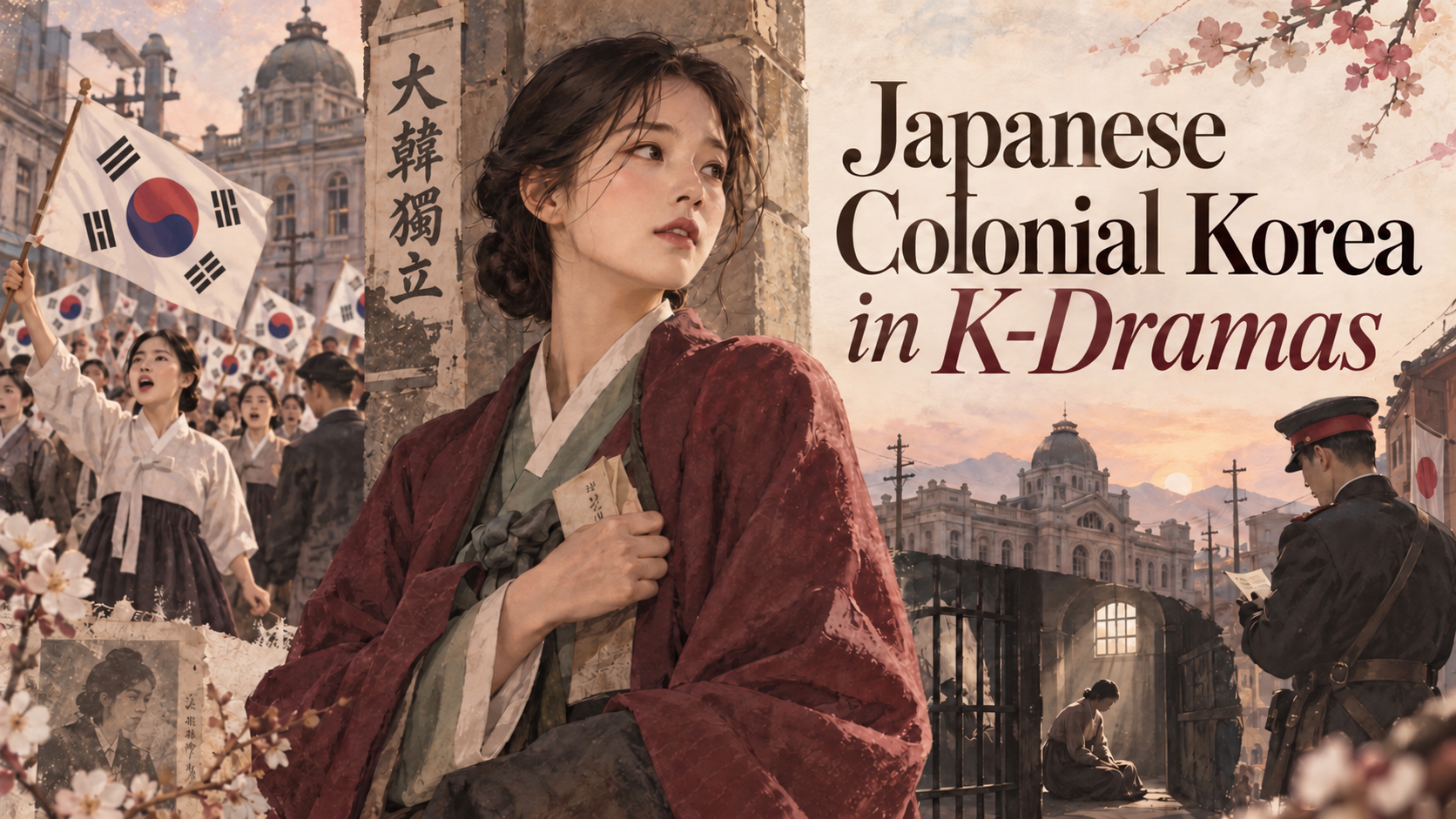
Why does Japanese Colonial Korea appear in K-Dramas through independence fighters, Japanese police, prisons, secret resistance groups, and hidden identities? Explore the real history behind Korea from 1910 to 1945.
Japanese Colonial Korea in K-Dramas: Why Does the Era Feel So Dark?
International viewers watching a K-Drama set during the Japanese colonial period may wonder, “Why are the characters so afraid of the Japanese police? Why do they risk so much to protect their Korean names, language, and identity?”
Japan formally annexed Korea in 1910 and ruled the peninsula until 1945. As Japan expanded its wars in Asia during the late 1930s and 1940s, assimilation policies became increasingly aggressive. Korean-language education and public use were severely restricted, Korean-language newspapers were closed, Koreans were pressured to adopt Japanese-style names through soshi-kaimei, and Shinto shrine worship was imposed in many institutions. Historical records also document the repression of Korean language activists and other resistance movements.
This is why scenes in K-Dramas where a character refuses a Japanese name, secretly teaches Korean, or hides Korean documents are not simply dramatic inventions. They reflect real historical tensions over language, identity, and cultural survival.
The Rising Sun Flag can also carry a very different meaning for Koreans than it does for many Japanese people. In Korea, it is often associated with Japanese imperialism and wartime expansion and can provoke strong reactions similar to the way other symbols of wartime aggression do elsewhere. Japan’s government, however, rejects the comparison with Nazi symbols and maintains that the Rising Sun design has broader historical and cultural uses in Japan.


Japanese Colonial Korea and the Independence Movement That Never Stopped
Colonial rule did not bring Korean resistance to an end.
On March 1, 1919, students, religious leaders, and ordinary citizens joined demonstrations calling for Korean independence. The March First Movement spread across the country and became one of the defining events of modern Korean history. That same year, the Provisional Government of the Republic of Korea was established in Shanghai.
Resistance continued afterward in Korea, Manchuria, China, and other regions. Armed independence groups, underground organizations, students, intellectuals, and activists all participated in different forms of resistance. Many were arrested, imprisoned, and subjected to harsh interrogation and torture under colonial policing systems.
For visitors who want to understand this history more directly, the Seodaemun Prison History Hall in Seoul is one of the most meaningful places to visit. It preserves the memory of independence activists who were imprisoned there during the colonial period.
This helps explain why Japanese Colonial Korea still carries such emotional weight for many Koreans today. The issue is not simply that “Korea and Japan did not get along in the past.” It involves the loss of national sovereignty, colonial rule, family memories, cultural suppression, and generations of resistance.


Forced Labor, Comfort Women, Cultural Suppression, and the Textbook Debate
The later colonial and wartime years brought increasingly severe forms of mobilization and repression.
Koreans were subjected to wartime labor mobilization and forced labor, while many women from Korea and other occupied territories were drawn into the Japanese military “comfort women” system under conditions that involved coercion, deception, and severe sexual exploitation. In official U.S. government usage, U.S. House Resolution 121, passed on July 30, 2007, described the so-called “ianfu” as women forced into sexual slavery by the Imperial Japanese military.
Other policies and abuses associated with Japanese colonial rule and imperial expansion included:
-Forced labor and wartime mobilization of Koreans
-The Japanese military “comfort women(sexual slavery)” system
-Wartime requisitioning of rice and natural resources
-Arrest, imprisonment, and torture of independence activists
-Suppression of the Korean language
-Pressure to adopt Japanese-style names through soshi-kaimei
-Requiring or coercing Koreans to worship at Shinto shrines
-Repression of the population through the military police system, including summary punishment and flogging
-Colonial education aimed at erasing Korean national identity and instilling loyalty to Imperial Japan
-Efforts to foster pro-Japanese collaborators and encourage divisions within Korean society
-Looting of cultural heritage and policies aimed at suppressing or eroding traditional Korean culture
In the wider history of Imperial Japan’s war in Asia, the Nanjing Massacre in China and the human experimentation and biological warfare research conducted by Unit 731 in Manchuria are also widely documented as major wartime atrocities.
The way this history is taught in Japan remains controversial.
It would be inaccurate to say that all Japanese textbooks completely hide colonial rule or wartime atrocities. However, the amount and language of coverage vary significantly. A recent academic study of approved Japanese history textbooks found that only a small minority of junior-high textbooks approved in 2021 and 2025 mentioned the “comfort women,” while issues such as the Nanjing Massacre and wartime mobilization were often treated briefly or differently depending on the publisher.
As a result, some younger Japanese people may finish school without encountering the same level of detail about colonial rule and wartime suffering that Korean students commonly encounter. That difference in historical education helps explain why Koreans and Japanese people can sometimes have very different understandings of the same period.
Once you know this background, scenes in K-Dramas involving Japanese police, secret resistance groups, prisons, Japanese names, or forbidden Korean language carry much more meaning.

Final Thoughts
Japanese Colonial Korea is not simply a dark historical backdrop for K-Dramas.
For Koreans, the period carries memories of colonial rule, cultural suppression, wartime mobilization, and violence—but also of resistance through the March First Movement, the Provisional Government, independence fighters, and underground organizations.
That is why a seemingly small K-Drama scene can matter so much: a character refusing to give up a Korean name, secretly carrying a Taegeukgi, hiding an independence document, or whispering in Korean while avoiding the colonial police.
Once you understand the history behind those moments, the drama becomes more than a period story. You begin to understand why these characters may be risking not only their freedom, but their lives.
Note from Rebecca:
Have a question about K-Dramas or Korean culture? Feel free to leave a comment below!