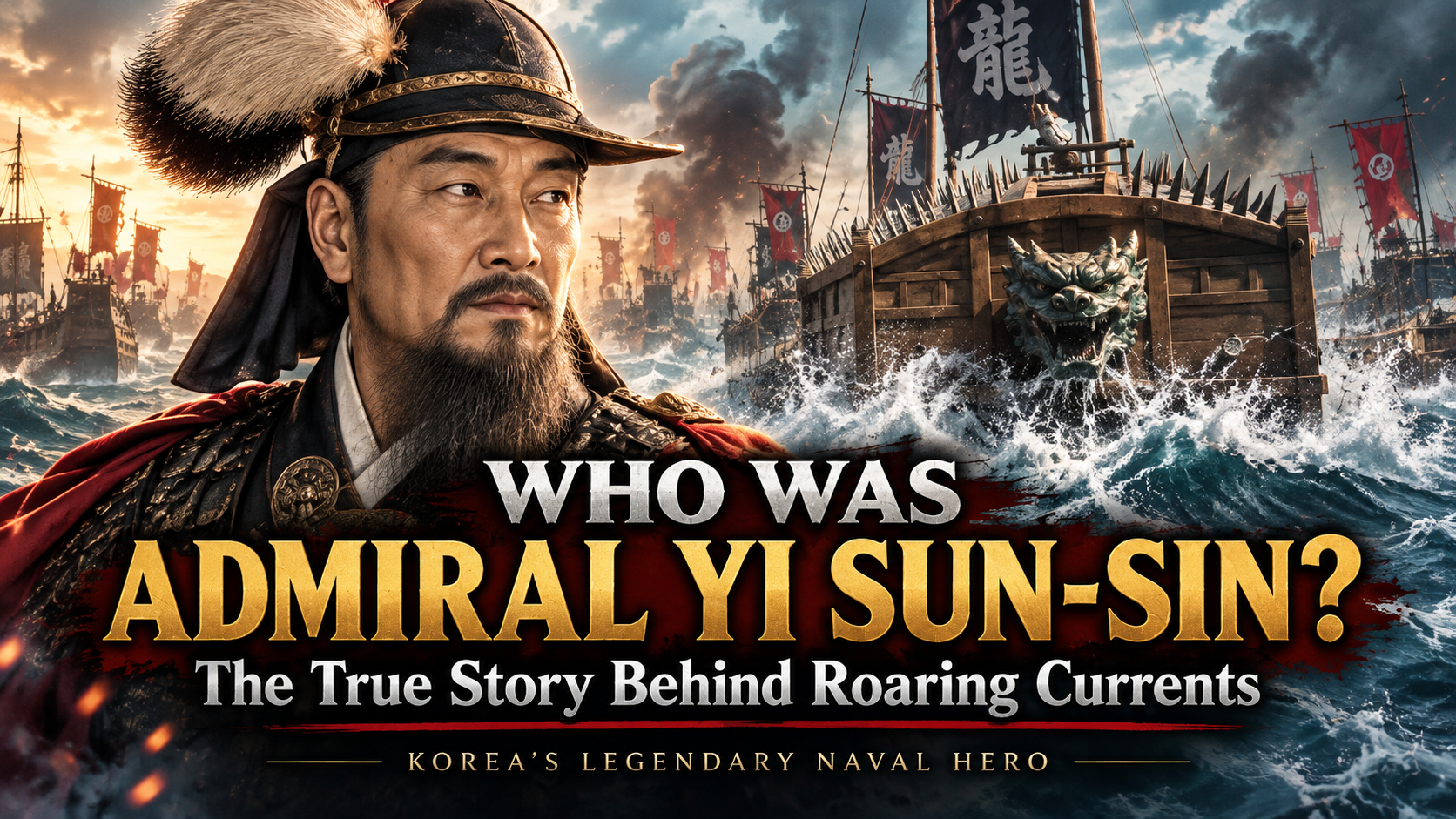
Admiral Yi Sun-sin, the real hero behind The Admiral: Roaring Currents, is one of Korea’s greatest historical figures. Discover his battles, turtle ships, and lasting legacy.
Who Was Admiral Yi Sun-sin?
Admiral Yi Sun-sin (1545–1598) was a military commander of Korea’s Joseon Dynasty who led the Korean navy during the Imjin War, which began with the Japanese invasion of Korea in 1592. As Japanese forces rapidly advanced north across the Korean Peninsula, Joseon faced a national crisis. At sea, however, the situation was very different.
Yi won a series of naval battles, beginning with the Battle of Okpo and continuing with major victories such as the Battle of Hansan Island. These victories threatened Japanese maritime supply routes and made it much more difficult for invading forces to transport troops and supplies along the Korean coast.
Admiral Yi Sun-sin was particularly known for carefully studying not only enemy movements but also tides, geography, currents, and weather before battle.
The famous turtle ship, or geobukseon, is also closely associated with him. It is more accurate to say that Yi helped improve and effectively deploy an existing type of Korean warship rather than simply inventing the turtle ship himself.
His victories were not the result of one secret weapon. They came from a combination of panokseon warships, naval artillery, well-trained sailors, intelligence gathering, and careful strategy.
The True Story of The Admiral: Roaring Currents and Admiral Yi Sun-sin
Released in 2014, The Admiral: Roaring Currents (Myeongnyang) is one of the best-known Korean films about Admiral Yi Sun-sin and helped introduce his story to international audiences.
Choi Min-sik, internationally known for his performance in Oldboy, plays Yi in the film. The story centers on the Battle of Myeongnyang in 1597, one of the most famous naval battles in Korean history.
Before the battle, Yi had been removed from command amid political conflict. After the Korean navy suffered a devastating defeat at the Battle of Chilcheollyang, however, he was restored as commander of the naval forces.
What he inherited was a navy in crisis.
Only a small fighting force remained, but Admiral Yi Sun-sin refused to abandon the sea. Instead, he chose Myeongnyang Strait as the place to confront a vastly larger Japanese fleet.
The strait is famous for its narrow channel and extremely powerful currents, which can change direction. Yi understood these conditions and used the geography and currents to reduce the Japanese fleet’s numerical advantage.
The movie naturally adds dramatic elements for cinematic effect. However, its central premise is based on real history: Yi confronted a much larger Japanese naval force at Myeongnyang and achieved an extraordinary victory by combining strategy with his understanding of the local waters.
For viewers who discover Admiral Yi Sun-sin through The Admiral: Roaring Currents, the real story can be even more remarkable than the movie.

Why Do Koreans Remember Admiral Yi Sun-sin as a Hero?
In Korea, Admiral Yi Sun-sin represents much more than a commander who won naval battles.
Despite his military achievements, Yi became the target of political suspicion. He was arrested, imprisoned, tortured, and stripped of his rank. He later served as an ordinary soldier in an episode remembered as baegui jonggun, or serving in the military without rank.
Yet when the Korean navy faced destruction, Yi returned to command and produced the remarkable victory at Myeongnyang.
His final chapter came in 1598 at the Battle of Noryang, the last major naval battle of the Imjin War. Yi was fatally wounded by enemy fire during the fighting.
According to the traditional account, Admiral Yi Sun-sin ordered those around him not to announce his death until the battle was over, fearing that the news could damage the morale of his troops.
The war ended as Japanese forces withdrew from Korea, but Yi did not live to see its aftermath.
Another reason we know so much about the man behind the legend is his personal wartime diary, the Nanjung Ilgi. The diary, now included in UNESCO’s Memory of the World Register, records years of wartime experiences. It contains not only military matters but also Yi’s worries about his family, illnesses, fears, frustrations, and sense of responsibility.
It reveals that the national hero remembered today was also a human being carrying an enormous burden.
More than four centuries later, Admiral Yi Sun-sin remains highly visible in modern Korea. His monumental statue stands in Gwanghwamun Square in central Seoul, and his portrait appears on South Korea’s 100-won coin.
The Lasting Legacy of Admiral Yi Sun-sin
If you first discovered Admiral Yi Sun-sin through The Admiral: Roaring Currents, the Battle of Myeongnyang is only one chapter of his extraordinary life.
From the Battle of Hansan Island and the turtle ship to Myeongnyang, political persecution, baegui jonggun, and his death at the Battle of Noryang, Yi’s life provides a fascinating gateway into Korean history.
That is why Admiral Yi Sun-sin remains one of Korea’s most respected historical heroes more than 400 years after his death.
For viewers who want to explore his story through Korean cinema, three major films cover different stages of his wartime career: Hansan: Rising Dragon, The Admiral: Roaring Currents, and Noryang: Deadly Sea.
Although they were not released in historical order, watching them as Hansan → The Admiral → Noryang allows international viewers to follow the major events of Yi’s story chronologically.