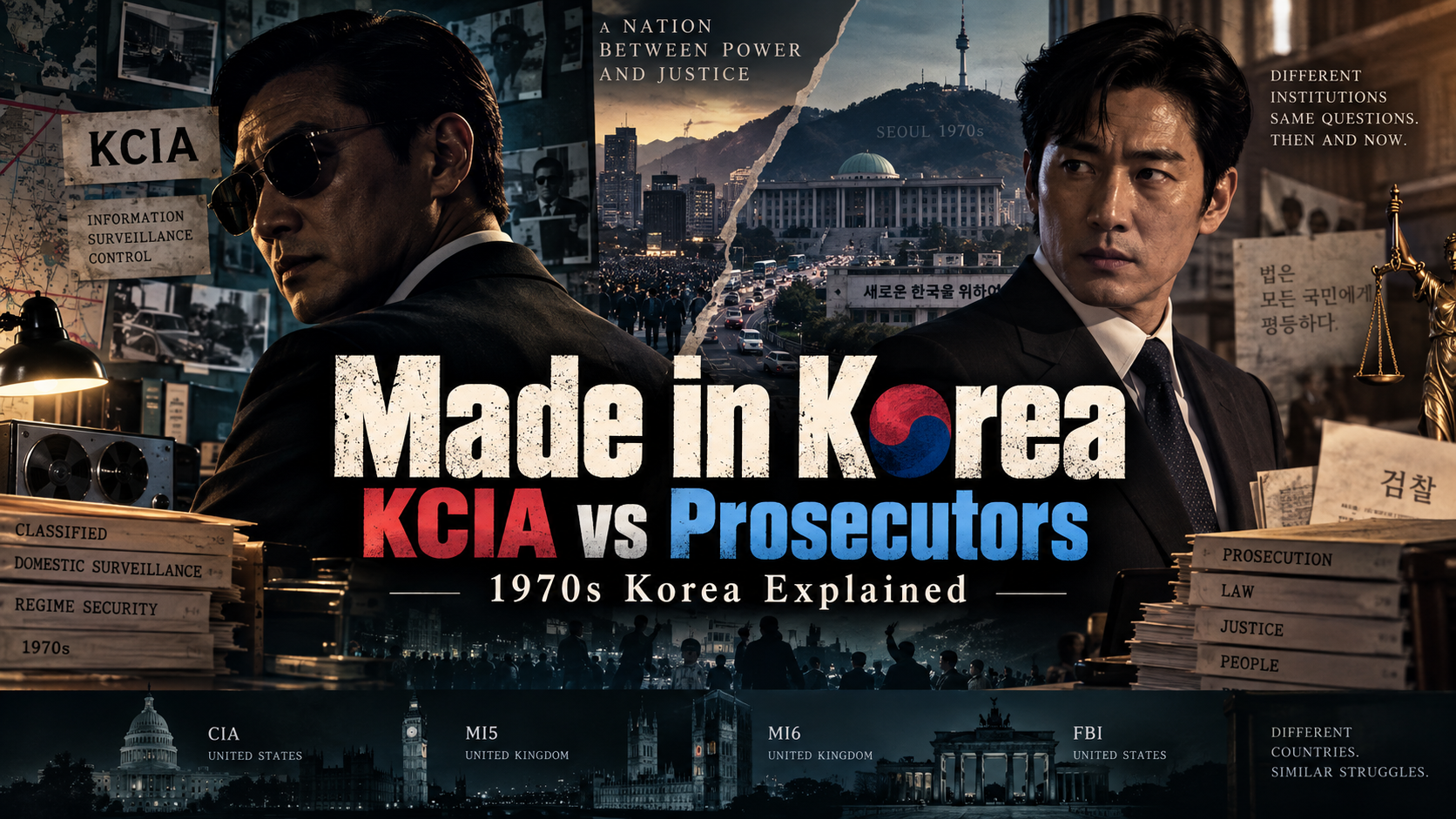
Explore the historical background of Disney+ K-drama Made in Korea, comparing the power of the 1970s KCIA and Korean prosecutors with the CIA, FBI, and European agencies.
How Was the KCIA Different from the CIA?
International viewers watching Made in Korea may initially think of the Korean Central Intelligence Agency (KCIA) as South Korea’s version of the CIA. Established in 1961, the KCIA handled national security and intelligence concerning North Korea and foreign countries, making some of its functions similar to those of the CIA or Britain’s MI6.
There was, however, an important difference. During the 1970s, the KCIA also exercised considerable influence over domestic politics and society. In the United States, the CIA primarily handles foreign intelligence, while the FBI is responsible for domestic counterintelligence and federal investigations. Britain similarly divides foreign and domestic intelligence between MI6 and MI5.
The KCIA of the 1970s combined broader functions and considerable power. This helps explain why KCIA figures in Made in Korea appear not only in matters of national security but also around politicians, businesses, and domestic affairs. Rather than simply viewing it as “Korea’s CIA,” it is more useful to understand the KCIA as a powerful institution within South Korea’s authoritarian political system at the time.
What Role Did Korean Prosecutors Have in the 1970s?
Korean prosecutors shared the basic responsibility of bringing criminal cases to court with prosecutors in the United States and Europe. But the structure of criminal investigations was different.
In the United States, police departments or agencies such as the FBI generally conduct investigations, while prosecutors decide how to pursue criminal charges. Britain also maintains a clearer distinction between police investigations and criminal prosecution.
Korean prosecutors historically exercised greater authority over both investigations and prosecutions. During the 1970s, when Made in Korea is set, politically sensitive cases could involve several powerful state institutions, including prosecutors, police, and the KCIA.
For this reason, it can be misleading to view a prosecutor in the drama as simply the Korean equivalent of an American district attorney. Understanding the broader authority prosecutors held within Korea’s political and legal system makes the characters’ actions and influence easier to understand.
Why Does the Conflict Between the KCIA and Prosecutors Matter?
For American or European viewers, seeing intelligence officials and prosecutors competing for influence over the same case may seem unusual. In modern democracies, intelligence agencies, police, prosecutors, and courts generally have separate responsibilities designed to provide institutional checks and balances.
South Korea in the 1970s was very different. The country was experiencing rapid economic growth while political power remained highly concentrated. The KCIA wielded considerable influence through intelligence and national security, while prosecutors possessed important legal powers involving investigations and criminal charges.
This does not mean the two institutions were always enemies—or always allies. They could cooperate when their interests aligned while competing over information, authority, and control of important cases.
Seen in this historical context, the tension in Made in Korea becomes more than a personal battle between individual characters. It reflects a larger struggle involving information, political influence, and legal authority.
Final Thoughts
Thinking of the KCIA simply as “Korea’s CIA” or a Korean prosecutor as the equivalent of an American prosecutor does not fully explain the power dynamics in Made in Korea.
In the 1970s, the KCIA had significant influence not only in foreign intelligence and national security but also in domestic affairs. Korean prosecutors also held substantial authority within the country’s investigative and prosecution system.
Understanding these differences makes the political struggles in Made in Korea much easier to follow—and offers international viewers a fascinating glimpse into the historical Korea behind the drama.
